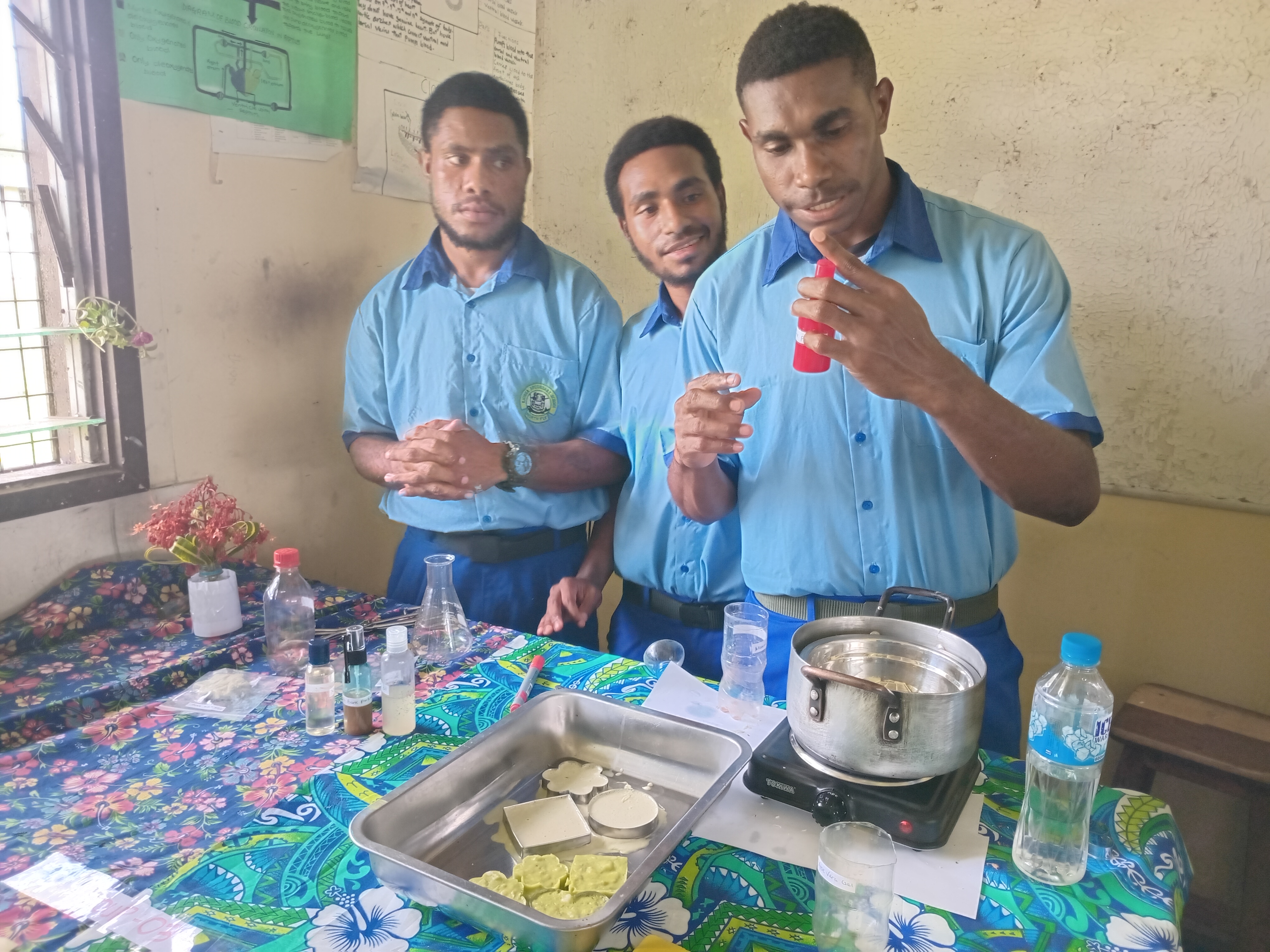
Fifty-one students from Kiunga Secondary School in the North Fly District of Western Province have successfully produced oils and soaps using locally available aromatic and herbal plants as part of a practical assessment project.
The Grade 11 students, studying biology, chemistry and agriculture, conducted research and processed various plant species into useful products during a practical lesson.
Plants showcased during the project included avocado, neem, massoia tree bark, turmeric, lemon, moringa, orange and pawpaw.
The activity demonstrated how communities in Western Province can use locally available herbal plants to process, preserve and market products for income generation and sustainable living.
Agriculture teacher under the school’s science department, Mrs. Esther Noah, said the project focused on aromatic plants found in Kiunga and nearby villages, with students tasked to identify suitable plants and produce oils and soaps.
She said the students applied their skills and knowledge effectively, proving that young people and communities in Western Province can use herbal plants to participate in small business activities.
“This was also a life skill student have learned so when they finish secondary education, continue into tertiary studies or stay at home, they will continue to apply these skills to sustain their lives,”
She added that the products developed by the students provide health and beauty benefits, including skin, hair, face and body care.
Mrs. Noah also highlighted that under the Standard Based Curriculum (SBC), students are now able to perform strongly in both theoretical and practical learning.
Science Head of Department, Mr. Sammy Jonne, commended both teachers and students for delivering the project, saying it would help students become skilled professionals in the future.
“Local students can use these life skills and venture into small business activities using aromatic and herbal plants available in their villages.”
“They can also share their ideas with people in the community so it can help them engage in small business activities.”
Mr. Jonne said the school first introduced the assessment project in 2025, and this year marked the second presentation in Term Two. He said the science department plans to continue and expand similar projects in coming years.
He encouraged students to value education and use their knowledge and skills to contribute to development in their villages, province and the country.
The learning activity also encouraged teachers to explore innovative teaching approaches that strengthen both theoretical and practical learning across all subject areas.
Kiunga Secondary School continues to implement the SBC system alongside Science, Technology, Engineering and Mathematics (STEM) learning approaches, with the science department leading practical STEM-related activities for students.