

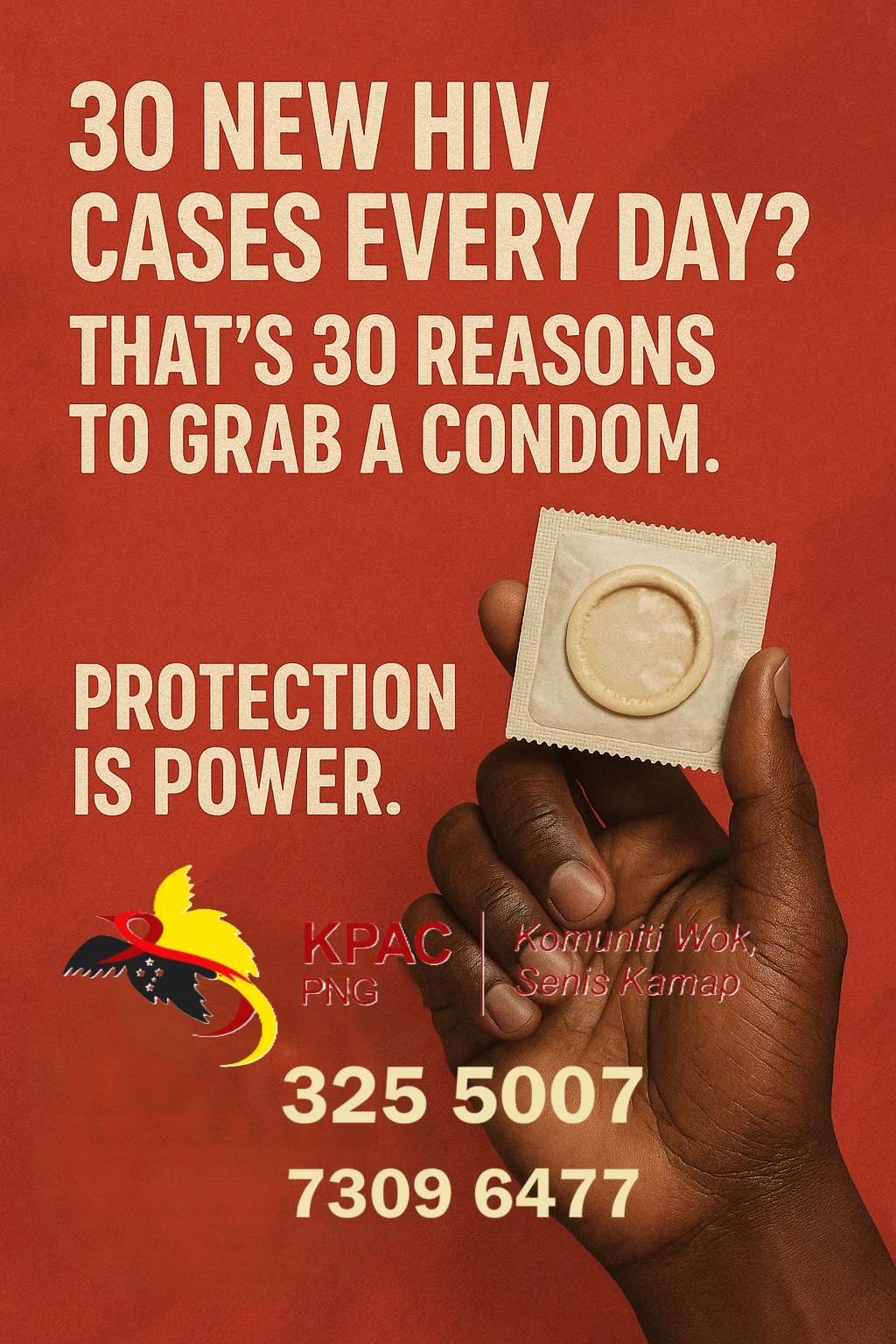
A community-based health outreach program in the National Capital District (NCD) is using education, awareness and free testing services to help reduce the spread of sexually transmitted infections (STIs) in Papua New Guinea.
Field Supervisor Jeffrey Lalio said that the initiative is being delivered through the Key Population Advocacy Consortium PNG (KPAC-PNG), supported by Department of Foreign Affairs and Trade (DFAT) and Catholic Health Services.
Mr. Lalio said the outreach teams are working across Northeast, Northwest and Southside districts, providing Community Based Screening and Testing (CBST) services at hotspot locations and communities.
Awareness and prevention remain key parts of the program.
“It’s all about disseminating information about HIV and STI prevention methods,” he said.
Alongside free HIV and STI testing, outreach teams also distribute condoms and educational materials such as pamphlets to community members as part of their awareness program.
The team screens for HIV, syphilis, gonorrhea and chlamydia, while also providing referrals for clients dealing with tuberculosis (TB) and gender-based violence (GBV).
The free testing process takes between 10 to 15 minutes and services are available to anyone seeking confidential screening.
“Anyone can come access the services that we provide,” Mr. Lalio noted.
Although treatment is not provided on site, clients who test reactive are referred to one of 16 partner clinics operating within NCD.
“We have referral cards that indicate whether you are HIV reactive or syphilis reactive so we can refer you to the nearest clinic,” Mr. Lalio explained.
The outreach project has been operating for the past nine months and continues to record increasing community participation.
Mr. Lalio also pointed out that the growing number of STI cases highlighted in the National Department of Health (NDoH) statistics reinforces the importance of awareness and early testing.
The outreach teams also maintain a call center service to help community members locate nearby testing sites as well as access information about available services.
Furthermore, he is encouraging all Papua New Guineans to take sexual health seriously and support awareness efforts within their communities.
“Get yourself tested and know your status,” he urged.
For those seeking immediate support or information, the National Response Center remains available at 73096477.