

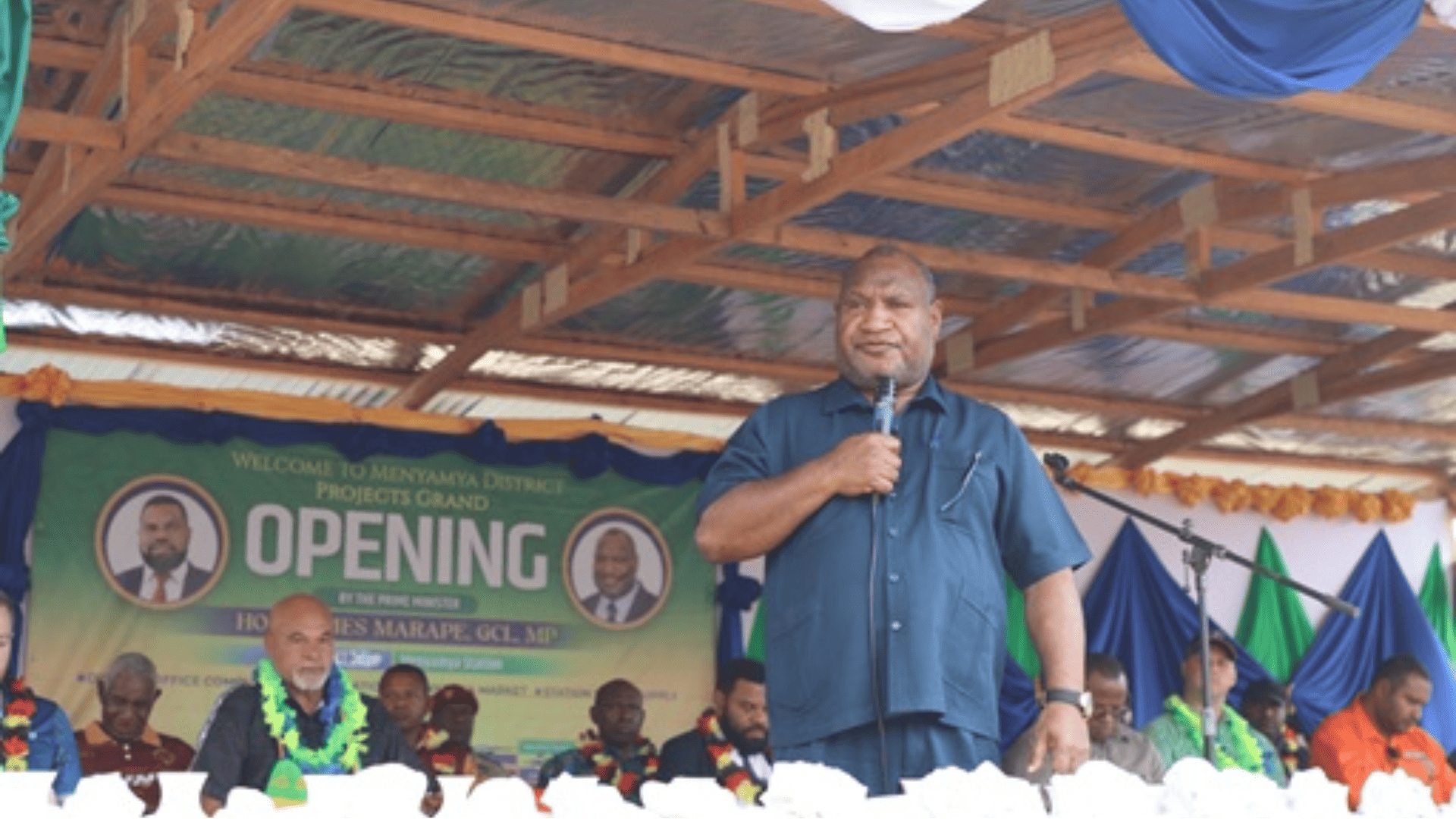
The Prime Minister (PM) while welcoming a new political party, is urging citizens to vote on merit rather than tribal loyalties, family connections as the 2027 National General Election approaches.
According to a press statement, PM Marape commends International Trade and Investment Minister Richard Maru on his launch of the Nesenel Unity Pati (NUP), while calling for greater political stability and constitutional reforms to strengthen Papua New Guinea’s democracy and economic development.
PM Marape says Minister Maru, a third-term Member of Parliament and experienced national leader, had every constitutional right to establish a political party under Section 47 of the Constitution, which guarantees freedom of assembly and association.
“I commend Minister Maru for his leadership and initiative. He has been a valued member of our coalition government, and Pangu Pati welcomes his new party into the political landscape,” he says.
Marape says Pangu Pati shared important policy priorities with Minister Maru’s party, particularly economic independence, downstream processing, resource mobilisation and special economic zones.
“These are areas where we share common ground, and we look forward to continuing our working partnership,” he says.
Speaking at the party’s fundraising launch, Marape stated that political stability was essential for sustained economic growth.
He says Papua New Guinea experienced 12 governments and six prime ministers between 1975 and 2002, when the economy grew from approximately K2 billion to K17 billion.
By comparison, he says, the economy expanded from K17 billion in 2002 to K46 billion in 2011 under Grand Chief Sir Michael Somare, reaching K79 billion in 2019 under former Prime Minister Peter O’Neill.
“We are now approaching a K140 billion economy in 2026. Political stability brings policy stability, which encourages investment, economic growth and development,” Marape says.
He proposed renewed national discussion on constitutional reforms that could allow Papua New Guineans to directly elect their Prime Minister, rather than leaving the decision entirely to Members of Parliament.
“The relationship between the legislature and executive has sometimes created political instability. We must seriously consider whether the people themselves should directly elect their Prime Minister,” he says.
Marape suggests that the proposal could be examined during the next parliamentary term, with a view towards possible implementation by the 2032 National General Election.
He says safeguards, including term limits and constitutional checks and balances, would be essential to prevent excessive concentration of power.
“The prime ministership is not the birthright of any individual or political party. Our people must vote for leaders based on their integrity, competence, policies and ability to deliver,” he says.
“Do not vote because someone is your relative or because you have been offered a plate of food. Vote for the leaders and parties you believe can build a better Papua New Guinea.”
PM Marape reaffirmed Pangu Pati’s commitment to its coalition partners, saying the party would seek continued cooperation after the 2027 National General Election, regardless of which coalition partner received the invitation to form government.
He concludes by wishing Minister Maru and his party every success.
“Our shared responsibility is to maintain political stability, strengthen our democracy and build an economically independent Papua New Guinea for future generations,” Marape says.