

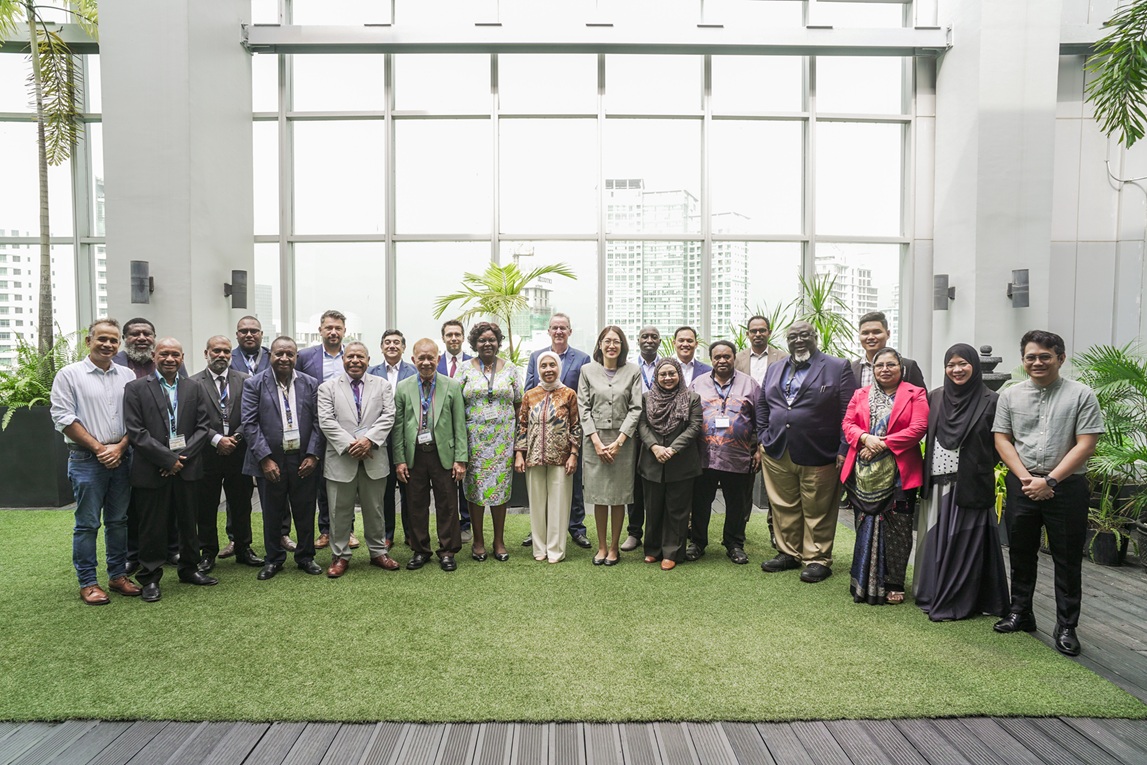
Papua New Guinea’s experience in improving the distribution of government funding to provincial and local-level administrations has been presented at an international forum in Manila, Philippines.
The National Economic and Fiscal Commission (NEFC) represented PNG at the inaugural Intergovernmental Fiscal Institutions Network (IGFIN) meeting held from September 28 to 29, bringing together senior officials from fiscal commissions, councils and related institutions to discuss funding arrangements, decentralization and service delivery.
The meeting provided PNG with an opportunity to share lessons from nearly two decades of experience following the 2009 intergovernmental financing reforms, while learning from other countries as the Government reviews its current Intergovernmental Financing Arrangement Review (IGFAR).
NEFC Chairman and Chief Executive Officer Alphonse Kapi Malipu MBE told participants that the key issue was not just how much funding was transferred to provincial and local governments, but whether the money was enough to meet the actual costs of delivering essential services.
Presenting on Social and Human Development Transfers, Mr. Malipu highlighted the challenges of distributing resources across PNG’s 22 provinces, 96 districts and more than 300 local-level governments.
He pointed to differences in geography, population, remoteness, infrastructure and financial capacity, which influence how much it costs to deliver services in different parts of the country.
Drawing on NEFC’s Cost of Services work, Mr. Malipu explained that PNG’s funding approach considers government responsibilities, minimum service standards, service delivery costs, fiscal capacity and equalization to address differences between provinces.
He said the effectiveness of funding arrangements should be measured by whether resources reflect local needs, reach communities and improve service delivery outcomes.
Participants also discussed funding for health, education and social protection, including the role of Provincial Health Authorities and the use of targeted grants, performance conditions and equalization mechanisms to improve social outcomes.
The discussions come as PNG undertakes the IGFAR process to determine which aspects of the existing financing system should be retained, amended or strengthened.
NEFC Principal Policy Analyst and IGFAR Project Manager Nigel Ainui said the commission’s approach was based on evidence and data, with the cost of delivering services and assessments of provincial fiscal capacity forming the foundation of the system.
Mr. Ainui said the 2009 reforms had significantly shaped how subnational governments were funded, but the experience gained over the years made a review necessary.
He said the establishment of Provincial Health Authorities, District Development Authorities and City Authorities had also created new questions about service delivery responsibilities, funding and accountability.
The ongoing review provides an opportunity to ensure funding arrangements remain aligned with these changing institutional structures.
Other NEFC representatives also contributed to the Manila discussions, with Director Policy Eric Kumasan participating in discussions on institutional roles in revenue sharing, while Director Fiscal Policy and Administration Idau Airi contributed to a session on reviewing state and provincial finances.
Principal Policy Analyst Valentine Sime shared insights on institutional performance, data and reform, while Mr. Malipu joined a panel examining stabilization grants and risk-sharing mechanisms.
The inaugural IGFIN meeting was convened by the Forum of Federations in partnership with the Philippine Department of Budget and Management, the World Bank Group, the Australian Government and the Canadian Embassy in the Philippines.
Discussions covered fiscal equalization, revenue sharing, social transfers, subnational fiscal oversight and emerging challenges in intergovernmental financial relations.
The meeting also established the foundation for an ongoing peer network, supported by a light secretariat to be hosted by the Forum of Federations.
Mr. Malipu welcomed the initiative, saying continued cooperation among fiscal institutions would allow countries, particularly developing nations, to exchange experiences and adapt lessons to their own circumstances.
For PNG, the engagement comes as the Government reviews its decentralization and funding arrangements, with the aim of ensuring public resources are distributed fairly, and essential services are delivered effectively across the country.