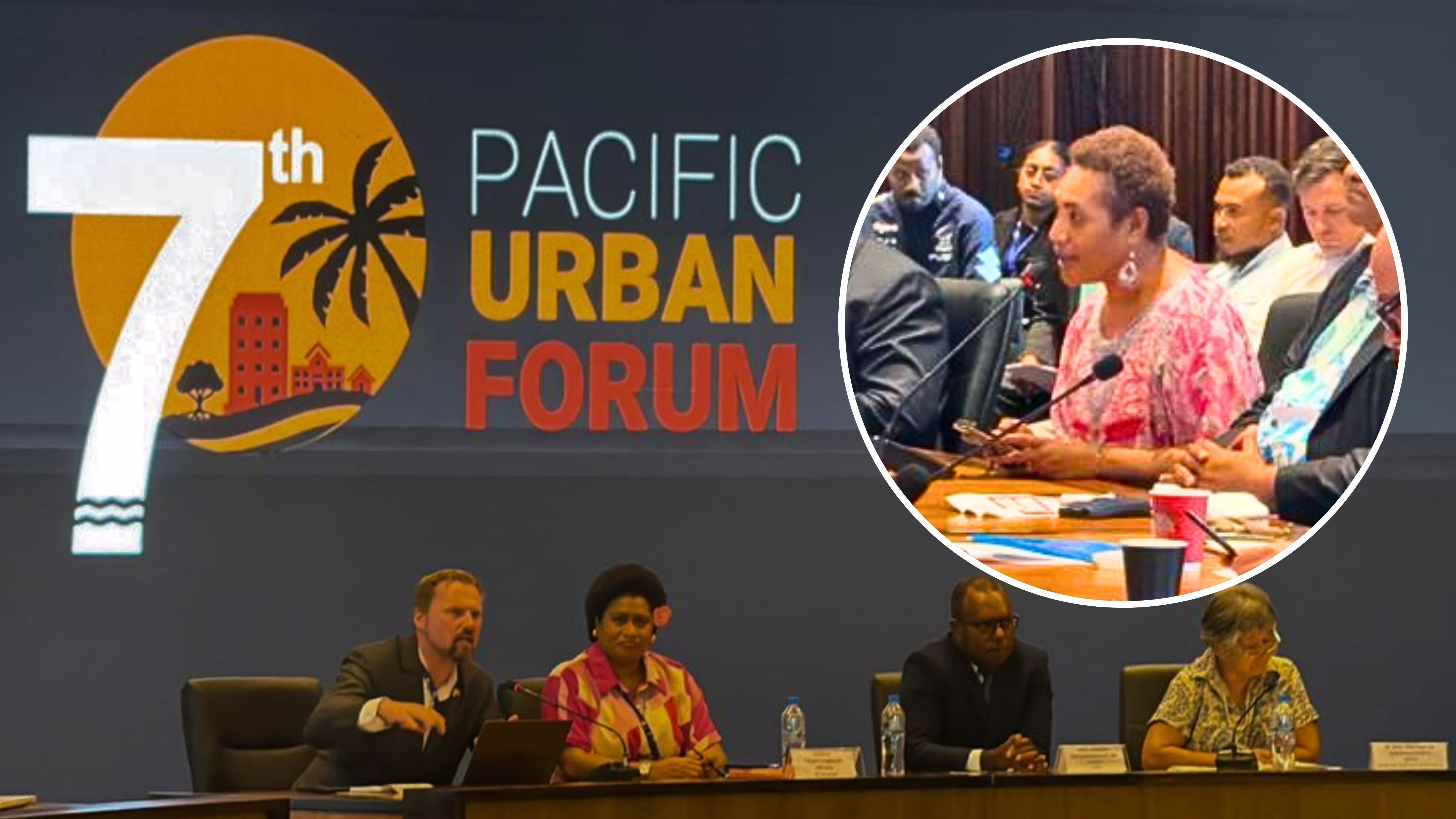
The extremely significant point of giving landowners their titles in order to empower then to participate in developments was raised by a stern female advocate of native lands yesterday during the 7th Pacific Urban Forum in Port Moresby city.
Papua Native Landowners Association President Ms. Lucielle Paru raised this during Plenary One of the 7th Pacific Urban Forum (PUF7) at APEC Haus, where land ownership, urbanization, and government policy took centre stage, drawing responses from the PNG National Housing Corporation and pacific regional leaders.
The discussion unfolded during the Question-and-Answer session of the plenary titled- “The State of Urbanization in the Blue Pacific,” where Ms. Paru raised concerns about Papua New Guinea’s approach to land and housing.
Inquiring with the National Housing Corporation Managing Director Able Tol, Ms. Paru questioned how informal settlements and urban expansion could be effectively managed when customary landowners are not fully empowered to plan, develop, or control their own land.
She stressed that without legal recognition of native land titles, urban development in PNG risks continuing a pattern of land alienation rather than inclusive growth.
“Give the landowners their titles and we shall direct your path,” she said, reinforcing calls for landowners to be placed at the centre of development decisions.
Ms. Paru extended her concerns to regional and international stakeholders, questioning why urban development policies often overlook customary land systems and whether there is genuine commitment to integrating native land rights into planning frameworks.
She also raised concerns about compulsory land acquisition by the State, asking what safeguards exist to ensure transparency, consent, and protection for landowners.
In response, National Housing Corporation Managing Director Able Tol acknowledged the concerns and outlined government efforts to protect customary land. He highlighted policies aimed at registering land and increasing landowner participation in development.
Mr. Tol said the government is working to ensure customary land rights are protected, noting that the vast majority of land in PNG remains under customary ownership, while State land is limited.
He also pointed to partnership models where landowners retain ownership while working with developers, describing these as pathways for inclusive development.
“We are trying our best to make sure customary landowners’ rights are protected, and to create avenues where they can participate in development,” he said.
His response focused on policy measures and ongoing initiatives, while broader questions around landowner control and legal empowerment remained central to the discussion.
The issue resonated across the regional panel, with representatives from countries including Tuvalu and Fiji acknowledging similar challenges.
Tuvalu’s Minister Ampelosa Manoa Tehulu supported the call for stronger recognition of landowners, emphasizing that people must remain at the centre of development.
“I totally agree… people are more important than anything else,” he said, adding that development decisions must not come at the cost of identity and land ownership.
Regional representatives also stressed the importance of governance systems that respect customary ownership, with examples from Fiji highlighting consent-based land negotiations as part of development planning.
The broader discussion highlighted a shared pacific reality as rapid urbanization is placing pressure on land systems, but solutions must be grounded in cultural identity and land ownership structures.
As the Pacific Urban Forum continues, the exchange underscored a key tension in Papua New Guinea’s development path: balancing urban growth with the rights of customary landowners.