

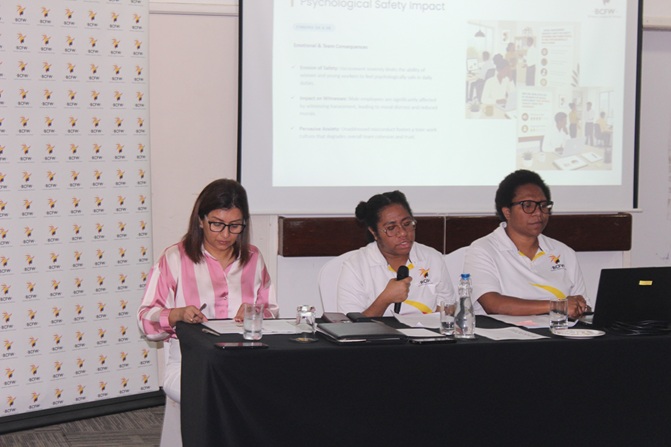
A new study by the PNG Business Coalition for Women (BCFW) has found that workplace sexual harassment remains a weighty concern for employees and businesses, affecting worker wellbeing, productivity and staff retention.
The Research on Sexual Harassment at the Workplace was conducted across seven major companies and involved more than 700 participants.
The research examined the prevalence of sexual harassment, barriers to reporting incidents and the impact of harassment on employee participation, productivity and businesses.
BCFW Board Chair Seema Dass Raju said the research was designed not only to document personal experiences of sexual harassment and identify barriers to reporting, but also to examine the economic cost to organisations and provide practical recommendations for workplaces.
The study found that 16.3 percent of employees reported experiencing sexual harassment at work, with women twice as likely as men to be targeted.
It also found that 20.1 percent of female workers had experienced harassment in their current role, while 46.1 percent of all staff had witnessed or heard about incidents.
Despite 91.7 percent of respondents being aware of workplace harassment policies, only 38.1 percent said they knew the exact steps to take when reporting an incident.
The research identified several consequences for employees, including avoiding certain people or workplace areas, considering leaving their jobs and taking time away from work.
It also found that 94.5 percent of targets identified co-workers as perpetrators, with unwanted jokes or comments recorded as the most common form of harassment.
Digital harassment was another major concern, with 40 percent of targets reporting experiencing harassment through digital platforms, particularly Facebook and WhatsApp.
Advocacy Officer, Sheena Puayil, stated that employees' willingness to report incidents was strongly linked to whether safe, confidential, and trusted reporting mechanisms were available.
Concerns about workplace relationships, retaliation, job security, and a lack of confidence in existing reporting systems were identified as barriers to reporting.
The research also mentioned psychological impacts extending beyond people directly targeted by harassment, noting that employees who witness incidents can also be affected.
“An interesting finding from the research is that men appear to be more affected by incidents they witnessed than by incidents they personally experienced.”
The study concluded that workplace sexual harassment is not only a wellbeing issue but also a business issue, with potential effects on productivity, staff turnover, recruitment and retention.
To conclude, Program Manager, Lolowo Gimiseve outlined six main areas of recommendations for employers: policies and procedures; education and training; digital safety; leadership accountability; reporting mechanisms; and support services.
“This recommendation provides a practical roadmap for employers to strengthen prevention, improve reporting systems, enhance accountability, and provide effective support to employees.”