

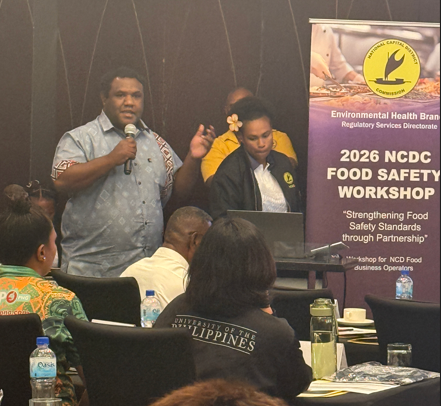
“Food Safety must be a shared responsibility and must remain in everyone’s business.”
This was the key message reiterated by various speakers representing different stakeholders when presenting to over fifty Moresby North-East food business owners at the 2026 National Capital District Commission (NCDC) Food Safety Workshop, which commenced on Monday, June 29th, 2026, at the Lamana Hotel in Port Moresby.
Safeguarding food safety from a regulatory perspective has been an ongoing priority for NCDC over the years, particularly in maintaining consumer safety and minimizing public health risks.
The idea of putting together this workshop and bringing together key partners and stakeholders with food business owners, was a necessary step in addressing the issue of food safety in Port Moresby.
The National Department of Health (NDoH) plays a critical role in ensuring that the food businesses operate in a manner that protects the health and wellbeing of communities.
The Food Sanitation Council and Secretariat is housed under the department and plays an oversight role to food safety, security, and also administering food legislation, while taking into consideration the consumers' health aspects in the country.
During his presentation, Mr. Paschalis Kinakava, Environmental Health Branch Manager for NDoH, told participants that fostering partnerships through workshops like this is highly important for food safety in the city, and also vital for the country’s growth into the future, especially where public health is concerned.
Mr. Kinakava emphasized the importance of shared responsibilities and the need for businesses to remain well-informed about operational standards and safety measures.
This awareness enables stakeholders to effectively carry out their mandated responsibilities, ensuring both compliance and preparedness in safeguarding food safety.
Meanwhile, Technical Officer for Environmental Health and Communicable Diseases from World Health Organization (WHO) Ms. Nola Eluh Ndrewei, spoke on what WHO is doing in protecting health through safer foods.
She highlighted that WHO is deeply involved in Foodborne Diseases Surveillance and the One Health Approach method.
Ms. Ndrewei revealed that while foodborne diseases are common in Papua New Guinea, they remain underreported.
These illnesses are frequently linked to poor hygiene, contaminated water, improper handling, and environmental factors that negatively affect public health, local economies, and businesses.
She explained that food safety risks typically arise from biological hazards such as bacteria and parasites, or chemical contaminants like pesticides and heavy metals.
She also listed some of the complex challenges concerning One Health and food safety in the country which is due to limited cold chain, informal food sector (street vendors, markets), water and sanitation issues, increasing imports and urbanization, and a fragmented and outdated legislation (Systematic Issues).
To effectively apply the One Health strategy to food safety, joint actions and a multisectoral collaborative effort are required.
“Effective food safety requires coordination across our health sector, agriculture and livestock, fisheries, environment and water authorities, local governments such as markets and sanitation programs, and more importantly our food business owners and the communities,” said Ms. Ndrewei.
Moreover, food business owners were reminded that food safety is not the responsibility of government only, but it is a shared responsibility.
The speaker reiterated that food business owners must practice safe handling, ensure their staff are trained properly, and be responsible in reporting outbreaks.
Furthermore, the general public and customers must also play their role in ensuring hygiene, preparing safe food, and reporting illnesses that arise from food consumption.