

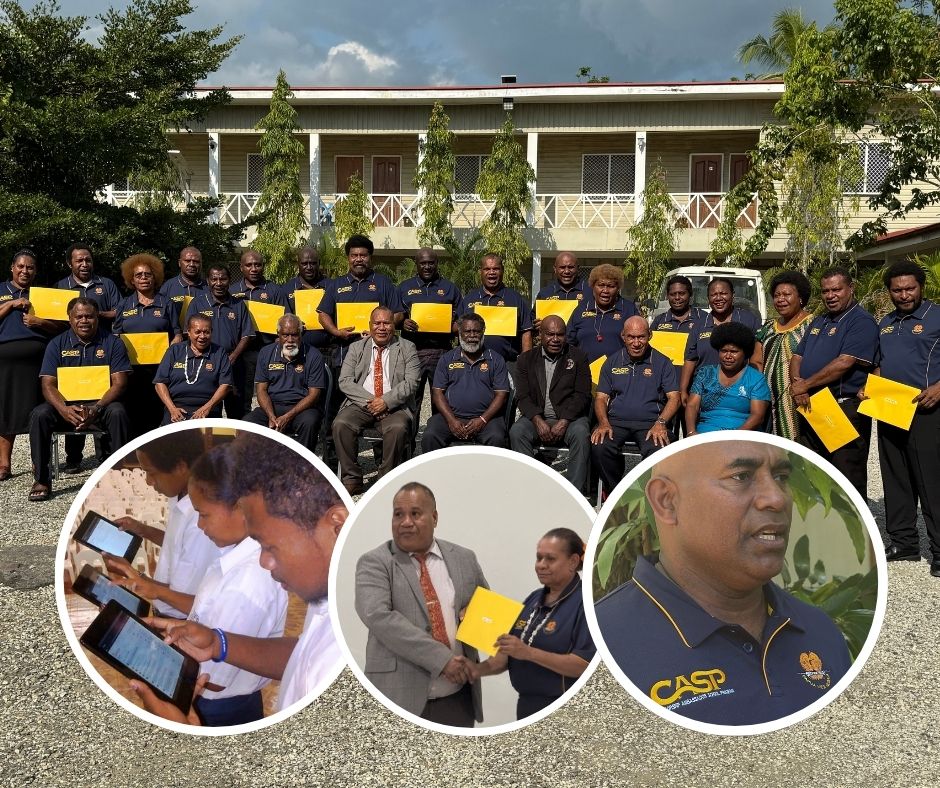
The National Department of Education (NDoE) is stepping up efforts to control mobile phone use in schools, rolling out a nationwide training program in partnership with the Office of Censorship through the Censorship Ambassador Schools Program (CASP) ahead of the launch of its new Mobile Phone Policy.
Eighteen education officials from the Momase and New Guinea Islands regions completed the latest phase of the program in Port Moresby, as part of a broader push to prepare schools for stricter enforcement.
This three-day training, held from April 27 to 29, 2026, at Dixie Bungalow located at 17 Mile, brought together secondary school inspectors, guidance officers, and NDoE officials to strengthen awareness and implementation of education policies.
The initiative comes as concerns grow over the impact of mobile phone use on students, particularly exposure to harmful online content and its effect on behaviour and learning.
Speaking at the certification ceremony, Chief Censor Jim Abani stressed the urgency of the issue.
“Today’s generation is living in the time of influence from all forms of media communication,” he said.
He warned that students are increasingly exposed to content that may negatively affect their behaviour and learning.
The CASP program is a joint initiative between the NDoE and the Office of Censorship, aimed at equipping education officers to act as policy advocates within schools and communities.
These officers are expected to return to their respective provinces to support awareness programs and help enforce upcoming policy measures.
Among those measures is the soon-to-be-launched Mobile Phone Policy, which will enforce a zero-tolerance approach in elementary and primary schools nationwide.
For secondary schools, mobile phone use will be allowed under controlled conditions for educational purposes.
Meanwhile, NDoE First Assistant Secretary for Guidance and Counselling, Philip So’on, also spoke on how technology has changed student behaviour.
“We never knew what pornographic until mobile phones came in, because in the past it was in magazines that were smuggled in,” he said.
He added that managing this shift will require support from both schools and parents.
Under the policy, schools will control mobile phone use during instructional hours, while parents are expected to guide students outside school.
Officials say the CASP training is critical to ensuring the policy is effectively implemented across the country.
The Port Moresby session marks the final phase of the training rollout, following earlier programs in the Highlands and Southern regions.
With the groundwork now in place, the NDoE is expected to formally launch the Mobile Phone Policy in the coming months.
Furthermore, the move signals a nationwide push to strengthen discipline, guide student behaviour, and create safer learning environments in an increasingly digital age.