

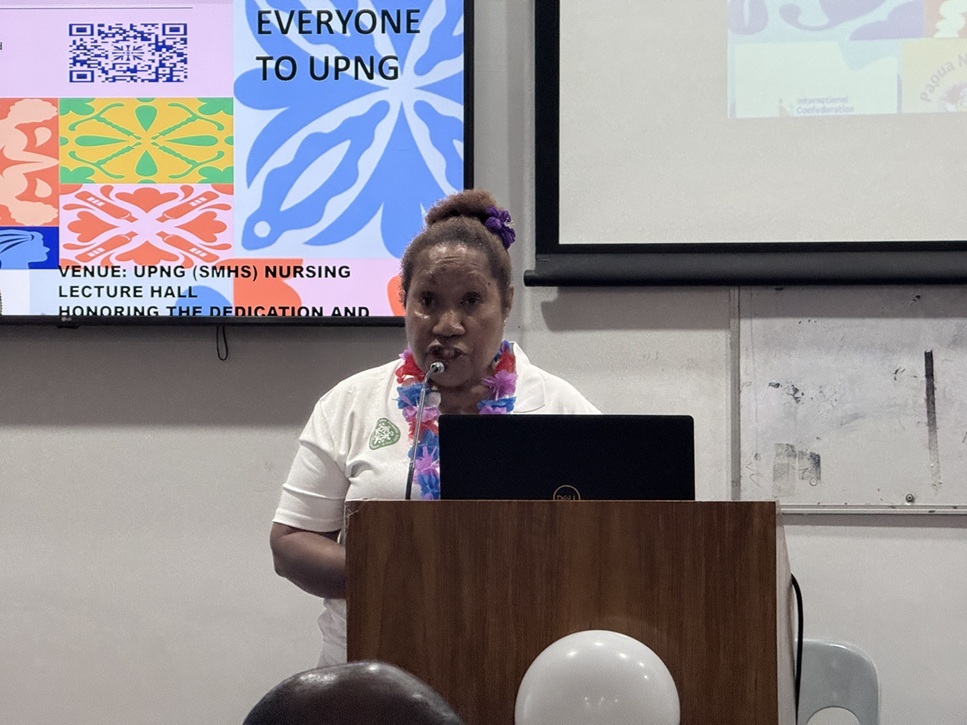
President of the Papua New Guinea Midwifery Society, Sister (Sr) Mary Sitaing, has called for urgent government action to strengthen the country’s midwifery workforce, warning that shortages, policy delays and growing pressure on health facilities are threatening maternal and newborn health services.
Speaking at the International Day of the Midwife 2026 celebrations, Sr Sitaing also formally welcomed a United Kingdom delegation and acknowledged the presence of senior health leaders, including the Health Minister and Health Secretary, describing it as a significant milestone for the profession.
“Please let’s make a welcome to the UK delegation,” she said. “Good evening, good morning to my boss, and all the distinguished guests. It’s my honour to be here.”
She said the attendance of top health officials marked a turning point in recognition of midwifery in Papua New Guinea.
“This is the first time we have both the Minister and the Secretary for Health joining us for this celebration,” she said.
Sr Sitaing acknowledged support from development partners including UNFPA, UNICEF and the Australian Government, noting their ongoing contribution to strengthening midwifery services.
She described midwives as “guardians of life” and the first point of contact for many mothers and babies across the country.
“Midwives are often the first point of contact for mothers and babies. They provide care from conception through to delivery and beyond,” she said.
Despite their critical role, she said the workforce remains under severe strain. According to figures presented, Papua New Guinea currently has just over 2,000 registered midwives nationwide.
“As of the 2024 figures, we have 2,002 midwives in the country,” she said, warning that this is far below what is needed.
Sr Sitaing said the country must significantly scale up its workforce to meet demand, proposing a target of 6,000 midwives by 2035.
“To achieve this, we need strong political support, increased investment and a clear strategy,” she said.
She outlined a four-pillar reform plan focusing on training, deployment, retention and workforce development, including a proposal to train up to 500 midwives annually through expanded training pathways.
She also noted that Papua New Guinea has five midwifery schools and confirmed that the current curriculum—recently extended to an 18-month program—is now due for review.
“The midwifery curriculum will now be due for review. We need to evaluate the changes and ensure it remains relevant,” she said.
Sr Sitaing warned that retention remains a major challenge, with several midwives leaving the profession due to poor working conditions.
“We must support our midwives better if we want to retain them,” she said.
She further called for the urgent endorsement of a long-delayed national midwifery policy and the creation of dedicated midwifery positions within provincial health systems.
“Midwives are autonomous practitioners and must be recognized as such within the health system,” she said.
Sr Sitaing concluded by calling for coordinated national action to ensure better outcomes for mothers and newborns.
“If we want better outcomes for mothers and babies, we must invest in midwives,” she said.