

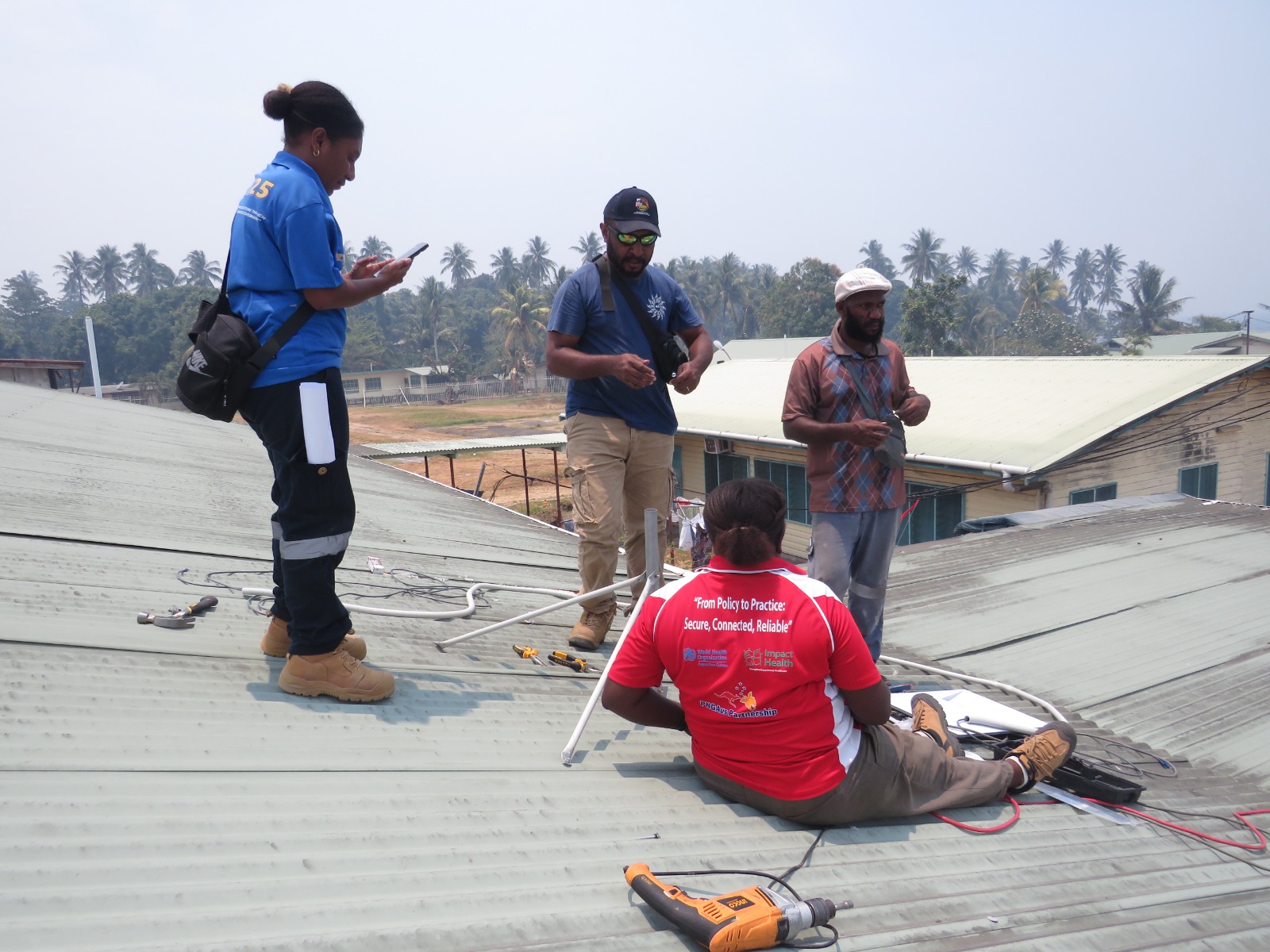
The newly opened Dr. Kaven Memorial Pomio District Hospital is taking a major step toward closing the healthcare gap in rural East New Britain after receiving Starlink satellite internet kits, a move set to improve medical communication in one of the province’s most isolated districts.
Covering 11, 000 square kilometres with a population of just over 100, 000, Pomio District has long faced tough communication challenges.
For years, keeping the area connected meant heavy spending, including a K1.5 million investment in Digicel towers.
Switching to satellite internet eases that pressure while bringing reliable digital access directly to rural health workers.
Defence Minister and Pomio MP Elias Kapovore recently witnessed the handover of the Starlink standard kits to the hospital by East New Britain Provincial Health Authority (ENBPHA) Chief Executive Officer Dr. Ako Yap, welcoming the upgrade for the district.
“Thank you ENBPHA CEO for this initiative. We need to improve connectivity and I am grateful that this project is supported by our partners as UNFPA.”
The connection at Pomio District Hospital is part of a wider digital push by ENBPHA, which is now the third provincial health authority in Papua New Guinea to roll out Starlink under the United Nations Population Fund (UNFPA) MeriLink Project.
Following a recent meeting with UNFPA representatives, Dr Yap confirmed the authority has bought 27 Starlink kits to serve 32 health facilities across the province.
While larger centres including Rabaul Provincial Hospital, Butuwin Urban Clinic, ENBPHA Headquarters, Warangoi Rural Hospital, and Kerevat Rural Hospital, are already connected, the authority is now focusing on remote clinics where fast data reporting is needed most.
“PHA has invested a lot in ICT because it is one of our priorities in our Corporate Plan, 2022 -2026.”
“Communication is very important when it comes to data input from those facilities that are hard to reach. We need health indicators to be improved to see the impact on the rural communities.”
Moreover, Dr. Yap noted that rough terrain and distance still make it hard for teams to reach the remaining rural sites, especially in Pomio, though the health authority is determined to finish the job.
“Rural health facilities’ geographical location is an obstacle, but we will get the instalments done for it is part of the health sector transformation.”