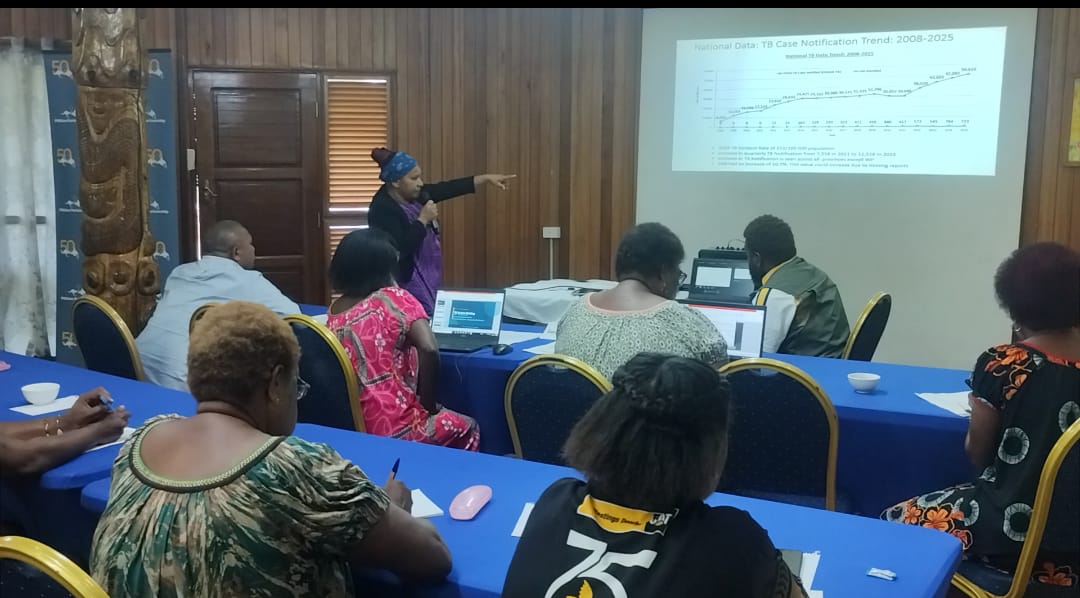
The East New Britain Provincial Health Authority (ENBPHA) successfully concluded a five-day tuberculosis (TB) review on Friday, June 05th, 2026.
The annual review is designed to assess how effectively the tuberculosis (TB) program identifies, tracks, and treats patients.
Like many other provinces, East New Britain will need to improve data collection as it has a rate of 203 cases per 100, 000 people.
In 2025, the treatment success rate of all forms of TB was at 58 percent.
Current data status shows that there is an urgent need to intensify contact tracing efforts and properly account for patients who are lost to follow-up.
With the technical support from the PNG and Australia Transition to Health (PATH) and the National Department of Health (NDoH) TB programs, the review allowed officials to identify gaps and understand the challenges face by TB Basic Management Unit (BMU) within their catchment areas.
Senior Medical Officer (SMO) Dr. Simberi Jojoga stated that it is important to have quality data to determine how well the program runs to ensure we are better serving the people in the community.
“Initially we started looking at the data from our provincial level and then over the course of the next three days we turned our focus on the 15 existing Basic Management Units (BMU) in the different catchment areas.”
“We want a resilient system that can continue to function, despite changes in staff, arise of issues or changes, the system must still allow to cater for all these. This is all part of the review.”
Current case notifications registered in the province is 1, 061, where on the actual data, not much is being detected as expected.
More needs to be done to generate people’s interest in testing, diagnose, be on treatment and outcome assessment.
The way forward for ENB health facilities, is to have community engagement through various existing systems currently functioning to have TB programs fit into, with Dr. Jojoga noting that the disease cannot be viewed as a standalone health sector issue.
“This is a cross-cutting issue problem, for every sector to be networking with existing community networks.”
“We want the community to be comfortable and know the signs and symptoms and support the six months treatment or longer if its drug resistance or some other serious forms of TB when on treatment.”
Continuous education and health awareness are a way forward to be promoted in the communities to allow more people to have knowledge and be comfortable in coming forward to receive treatment.