

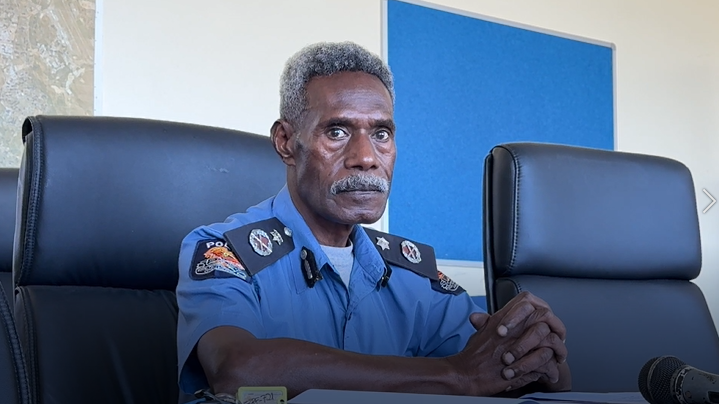
The country's growing cybercrime threat is exposing critical gaps in the Royal Papua New Guinea Constabulary's ability to investigate digital offences, with Head of Crime Division Assistant Commissioner Hodges Ette calling for more specialist officers, improved technology, and reforms to the country's Cybercrime Act.
Assistant Commissioner of Police and Head of Crime Division Hodges Ette raised the concerns during an interview with PNG Haus Bung following the official handover of Project Blue Pacific equipment to the RPNGC Interpol National Central Bureau at Police Headquarters in Konedobu on Friday, June 26.
ACP Ette said the Cybercrime Unit is operating with fewer than 10 officers despite the rapid rise in cybercrime and the misuse of social media across the country.
"The Cybercrime Unit is very small. There are about five personnel, and that is insufficient to serve the whole nation."
He said the Constabulary is working towards decentralising aspects of cybercrime investigations by building the capacity of police stations to deal with less complex digital offences, while the specialist Cybercrime Unit at Seven Mile focuses on more sophisticated investigations.
"We are also working in collaboration with NICTA and DICT so that certain forms of cybercrime can be dealt with at the police station."
ACP Ette said police are working closely with the National Information and Communications Technology Authority (NICTA), which in March donated much-needed equipment under a memorandum of understanding (MOU). Police are also working with the Department of Information and Communications Technology (DICT) to strengthen cybercrime investigations and improve the ability of frontline officers to respond to online offences.
He also called for a review of the Cybercrime Act, saying the legislation requires stronger procedural provisions to better support investigators handling digital evidence while meeting constitutional requirements.
"We would also like to have a look at the Cybercrime Act. There are several provisions in there where the legislation does not come outright with specifications as to methods, processes and procedures."
ACP Ette said the Commissioner of Police and the Minister for Police are expected to discuss possible amendments to strengthen the legislation and improve its implementation.
Addressing the growing misuse of social media, he warned that many Papua New Guineans remain unaware that their online activities can amount to criminal offences.
"The trend of cybercrime is increasing in this country, and many of our people don't understand that when you make a post on Facebook or social media, there are consequences."
He also raised concerns over weaknesses in SIM card registration and identity verification, saying stronger regulation of service providers would significantly assist police investigations.
"Why are we still having SIM cards without proper registration? Those are things that need to be addressed."
ACP Ette acknowledged the recent donation of equipment under Project Blue Pacific, supported by the Australian Federal Police, New Zealand Police and the United Kingdom's National Crime Agency, saying the assistance would strengthen Papua New Guinea's capacity to combat transnational crime while supporting modern policing initiatives.
However, he stressed that sustained investment in specialist investigators, modern technology and stronger legislation will be essential as Papua New Guinea continues to face increasingly sophisticated cyber threats in the digital age.