
Posts by Kerebi DAVID | PNG Haus Bung
POSTS BY AUTHOR
Kerebi DAVID
Author

Kerebi DAVID

REPORTERS COMPLETE WORKSHOP ON FISHERIES
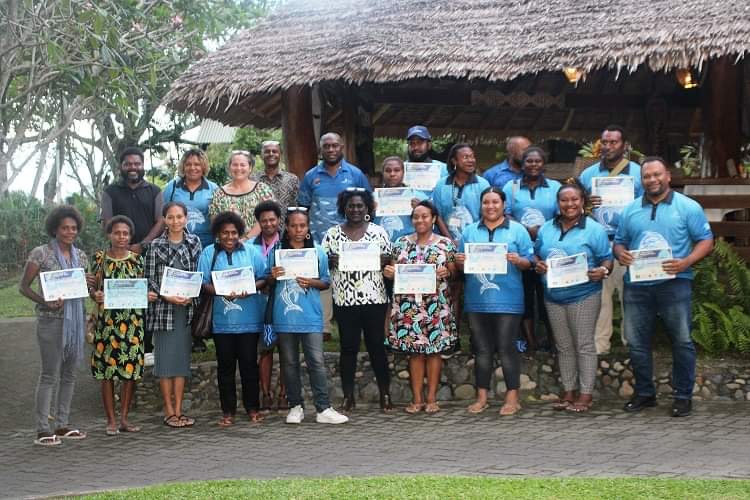
A total of sixteen reporters and two officers from the East New Britain (ENB) Provincial Administration, we’re the proud recipients of certificates after completing a three-day workshop in preparation for the upcoming 8th Pacific Tuna Forum to be held in Port Moresby this month. Reporters were taught about the functions of the National Fisheries Authority (NFA) and the Tuna Industry in the country, the region and globally. They received training and insights to the Blue Pacific Continent and Tuna Sustainability, Tuna Vessels, Tuna markets, the Climate Change and its effects on Tuna, the Fukushima Toxic waste and its effects on Tuna, the Regional and global implication of Illegal, unreported and unregulated fishing in the Pacific and more, including the role NFA plays in the Tuna Industry and other fisheries industries. Speaking at the presentation ceremony NFA Chairman Mr. Lauri Williams thanked the facilitators for imparting their knowledge about the background on what the fisheries sector does, not only in the country, but around the globe. “We are a government entity, but we are not just a government entity like all the others, we are a commuting authority.” “The work that NFA does relates to other government bodies around the world, the secretariat office around the region, therefore it is important to do what we are doing” “We brought NFA from when it was just a department of Fisheries, Agriculture and Livestock and transformed it into a competing Authority.” “Thus, Media plays a very important role in telling the story of the fisheries sector moving forward,” said Mr. Williams. Williams highlighted that Media not only plays an important role in the fisheries sector but also in the Tuna sector. He highlighted that Tuna is a common denominator that binds the Pacific together. Williams added that no one owns Tuna; it moves around, Tuna is the fish that never sleeps. Tuna Travels and there is a lot of technical background to how to understand how the Tuna industry works. “It’s how we manage it, how we work with our brothers in the Pacific and our key stakeholders that control the market, the EU market and the Americans, we all need to work together and participate more in the industry,” he said. Mr. Williams encouraged all the reporters to do more research, more investigation into the sector and the industry itself so that accurate stories can be told to the people. “It is a lucrative industry but a sustainable industry also, if we manage it well now, our future generations will still enjoy the benefits of the Tuna industry.” The workshop was hosted by the NFA in Kokopo and was held at the Kokopo Beach Bungalow from Wednesday 30th August to Friday the 1st of September. Of the sixteen reporters that participated, twelve were from Port Moresby and four from Kokopo.
Published on September 3, 2023
PNG CONTINUES TO BENEFIT FROM EU FISHERIES MARKET
The Pacific is the only region in the world where the major tuna stocks are biologically healthy and much of the tuna from the pacific are sold in the European Union (EU) market, the single largest market for fish and fishery products worldwide. Papua New Guinea (PNG) is privileged to be part of that, by having access to the EU market through meeting the Health Certificate and Catch Certificate criteria. PNG supplies Skipjack Tuna, Yellowfin Tuna, and Albacore Tuna to the EU market. In 2019, the quantity of fisheries exports was doubled from 2014 with 196,000 tons of products exported within five years, with a total export value of K1.3 billion. PNG’s canned tuna exports benefit from a 24% duty exemption into the lucrative EU market, further leveraging the growth of the PNG Tuna processing sector. Whilst PNG is thriving in the EU Market, the National Fisheries Authority (NFA) is also exporting other fisheries products into the Chinese market like dried sea cucumbers, prawns, shrimps, lobsters and crabs. And over the years the National Fisheries Authority strives to keep the country’s tuna industry in the Global market by maintaining its standard and also by improving its service and management system locally.
Published on September 2, 2023
REAL TIME DATA ON FISHERIES ACTIVITIES
One of the most important parts of tuna trade in the region and as well as the globe, is the efficiency in providing factual timely data, something which the National Fisheries Authority (NFA) has improved on since 2015 with its Asset Track System. Data report is very important as it plays an important role for NFA to continue maintaining its Certificate of Health and Certificate of Catch in order to have access to global markets as well as the European Union (EU) market and the Chinese market. Mr. Herman Kisokau from the Training and Support from the Rabaul NFA office stated that the Asset Track System is fully encrypted, and it is Digi set certified, meaning that it is very secure and 100% safe. “This Asset Track System is used within the National Fisheries Authority only and it is web based, meaning you can connect and access it where there is internet service.” This system is used by PNG Licensed vessels to send in or provide their data through their transponders, they can also provide there GPS locations and intervals to the licensed and fishing authorities and the GPS locations and intervals are displayed on the system. Mr. Kisokau also stated that this system is used by the observer who is on the fishing vessels observing the fishing process. “Back in 1996 upwards, everything was manual, and we did not know what was happening on any vessel until it came to harbor and the observer submits the report.” “However, this has changed, the observer at sea is using a tablet and a transponder they carry every time, and they send real time data back to the observatory.” Also,the fishing vessels are using tablets and the software and sending the same information to the authority. “Three data sets are coming in at one time, vessels date, observer data and the industry data to the authority and displaying on one screen in real time.” When the data is received, the licensing and data management team are responsible for the data, they start to separate the data and give it to responsible business groups in authority to manage the data. “This is a game changer as we are able to track everything on a vessel through our observer who is on board, thus we are able to also know if the observer is alright or is at risk unlike in the past.” “With the use of this system, the National Fisheries Authority was able to save five vessels from sinking, because the observer on board sent an SOS through.” Tuna fishing is the biggest business activity in the fisheries sector; thus, data collection is endless and to translate all these into electronic now, just makes work easier. This data helps NFA access the market system and maintain its position in the Global tuna and other fisheries product markets.
Published on September 2, 2023
JOURNALISTS URGED TO PRACTICE ETHICAL REPORTING
In recent times the government has been trying to hold media in Papua New Guinea accountable to things that catch everyone's attention, and when the government is trying to do that, they are simply disregarding every good that has been done by the media. This was emphasized to journalists in Kokopo by Media Council President Mr. Neville Choi. Mr. Choi said that it is even worse that the government is seeing the mainstream media, traditional media in the same lance as social media. “Because they see two different things through the same lance, they feel that they can hear the mainstream media, but they cannot control the social media, so they will just group all into one and come up with a policy or law that gives them more control,” said the Media Council President. “However, as journalists we need to see that we can overcome this through ethical reporting and many times despite us practicing it, we often never really think about it.” He added that the government of the day does not understand that as journalists, ethics and good moral judgments are the foundation of what journalists do. “Ethics combined with honest, unbiased and well researched reporting are the two things that set the foundation to build credibility and right now that is what’s under attack, our credibility,” said Mr. Choi. Mr. Choi further stated that in recent times, the national leaders have led the charge against what they consider to be unregulated media, practicing low standard journalism. “The only counter to this, is for us, as media practitioners to ensure that our reporting is beyond reproach, criticisms or questions.” Everyone understands that politicians cannot make the laws or govern things like the media because they are part of the political race regardless of what they say; they remain politicians, part of a national political race. “However, ironically the government is usually the biggest critic of the media because their work involves and impacts the lives of everyone, and as journalists report on the impact, the government turns and criticizes the media, despite journalists just doing their normal job,” he added. “Question is how do we stop this?” “The answer is really simple; all journalists must follow media ethics because ethics in the line of reporting the news is the first and the last safeguard against bias.” Whether we realize it or not, media ethics remains the core of our everyday work as media practitioners.
Published on August 31, 2023
SEX REVERSAL TILAPIA FEED HELPS FISH FARMERS
“Fish farming was a bit slow when it was first introduced by the National Fisheries Authority back in early 2000.” This is from Mr Jacob Towa, owner of Towa Fish Breeding and Hatchery Farm in the Western Highlands Province. Mr Towa said this was mainly because fishponds have male and female fish together where they keep on producing more and tend to grow slow and small, thus making farmers lose interest in fish farming. “However, with the introduction of the sex reversal feed this has greatly improved fish farming in the Highlands.” “Breeding process of hatchling to fingerlings this has greatly improved fish farming, where breeding is done in breeding farms where only male fingerlings are sold to fish farmers.” He added that the breeding process is a delicate job where he has to feed and look after the hatchlings for up to 21 days and when they become fingerlings, that is when he sells them off to fish farmers. “It’s quit a skilful and delicate job where these hatchlings have to be fed 5 meals a day, and I feed them with Sex Reversal Tilapia Feeds (SRT) so the hatchlings can develop into male tilapia fish only.” “The Sex Reversal Feeds is a game changer, now we can control and grow bigger freshwater fish and farmers do not have to go to the whole process of handling hatchlings to fingerlings, but they buy fingerlings from me at my breeding and hatchery farm and grow their own fish, and all the fingerlings I sell to farmers are only male.” “Male fish tend to grow faster and bigger than the female fish, thus bringing in more income for the fish farmers and the breeding of male fish is done by feeding all hatchlings with the sex reversal feed,” said Mr Towa. “Takes 21 days of feeding and 5 times a day which is 8am, 10am, 12pm 2pm and 4pm and SRT is the very first feed we give a hatchling when it comes out of the eggs.” Mr Towa further told PNG HAUSBUNG that the SRT Feeds are very expensive and hard to buy from any store, so they had to travel to Port Moresby and Aiyura in Eastern Highlands Province to buy new supplies. However, recently National Fisheries Authority has given 9 Hatchery farmers training on how to produce their own SRT feeds and right now Mr Towa is making his own SRT feed. “I am excited that now I can make my own SRT feed, I was given the formula to make SRT feed and this has saved me some money and trips.” With more trips and money saved, he said he has more time now to concentrate on giving trainings, guidance and help to new and interested fish farmers.
Published on August 29, 2023
NSL CLARIFIES DECEASED ENTITLEMENT PAYMENTS
Nambawan Super Limited (NSL) would like to correct misleading information published in a recent front-page article in one of the daily newspapers in one of the daily newspapers regarding a person claiming to be the rightful beneficiary of a late Member. NSL would also like to provide some clarity around the process which beneficiaries are required to follow to access a deceased Member’s retirement savings. NSL stated that the person featured in the front-page story is in fact not a nominated beneficiary of the late Member, as incorrectly stated in the newspaper article. The late Member had nominated another person as the rightful beneficiary and NSL has been in contact with the correct, designated beneficiary and is following the standard process governed by the Superannuation (General Provisions) Act 2000 to progress the payment of the late Member’s entitlements to the nominated beneficiary. As per this process, the withdrawal application was concluded, and payment was made to the correct nominated beneficiary after all additional documents and requirements were provided to NSL. The headline of this article was also incorrect in implying that the Authorised Superannuation Funds of PNG operate on a “no next of kin, no payment” basis. NSL want to clear this and highlight that this is not the case, in instances where a deceased Member has not nominated any beneficiaries or if there is conflicting information left by the late Member or the family of the late Member, the process is lengthier as NSL is required to investigate. This is an important verification process and ensures that genuine family members’ and beneficiaries’ interests are protected. The unlisted beneficiaries must provide proof of identification and proof of relationship to the late Member. Any additional requirements will be communicated to the unlisted beneficiaries on a case by-case basis depending on their specific circumstances. Interviews are also conducted as a requirement for the verification process and all this information is then reviewed by NSL before a decision is reached and entitlements are then processed and released. For cases where the beneficiaries are listed, the following standard documentation is required; A. Completed Separation Authority Form B. Copy of late Member’s Valid ID (e.g.: driver’s license, work ID, or passport); C. Statutory Declaration Form confirming the beneficiaries’ identity, date of birth, and their relationship to the deceased member; D. Nominated Beneficiaries over 18 years of age must have an active bank account and provide copies of their latest bank statement with a valid form of ID; and E. Demise Letter from Employer and if all required documents are submitted without errors and the beneficiaries are readily available to be interviewed, the entire process takes between three to five days to complete, with payments made to the beneficiaries’ accounts without delay. The Fund strongly encourages Members to protect their loved ones by ensuring that they review and update their list of beneficiaries at least once a year and it takes only a moment of their time and ensures a smooth and quick process for those they leave behind. If left undone, however, this can have a profoundly negative impact on families, as they now not only have to deal with the grief and loss of their loved one but also the stress of having to deal with a process that is longer and more strenuous than it needed to be. NSL seeks to make the process simple; however, the failure to nominate beneficiaries makes it difficult for all parties. We are obligated to protect our members’ funds and we take this role very seriously because unfortunately, there are many people trying to access funds that don’t rightfully belong to them. As a Trustee, NSL works to ensure that we abide by the principles of good corporate governance and operate with no other purpose, other than to serve the interests of our members, by growing and protecting their savings and entitlements. Our members can check their current listed beneficiaries by logging into our online member portal through our website or the Nambawan Super App or they can also call or email our Call Centre team or visit us at their nearest Branch. Members can update their details by filling out a “Member Detail Update Form” (MDUF), have it endorsed and stamped by their authorised designated human resource signatory, and lodge it at their nearest Branch or via email to our Call Centre team. The MDUFs can be downloaded directly from the NSL website, requested via email or from our Call Centre agents, or picked up from any of our 23 Branches nationwide.
Published on August 28, 2023
USAID ASSISTS ENDANGERED LEATHERBACK TURTLES
The United States Agency for International Development through its PNG Lukautim Graun Program (USAID LGP) is working to protect Papua New Guinea’s rich biodiversity with the awarding of small grants to non-governmental organizations (NGOs). These funds will reduce threats to biodiversity, strengthen traditional landowner’s rights, and promote women’s economic empowerment. Madang based Non-Government Organisation, Mas Kagin Tapani Association (MAKATA), is among the recipients of these small grants involved in empowering local communities to protect species of critically endangered leatherback sea turtles that share their coastal regions. With grant support from USAID LGP, MAKATA conducted community journalism training at Alexishafen, Sumkar district, Madang province, to equip coastal communities with skills and tools to create impact news content that depicts the protection of these turtles and other marine species. Over a two-week period, 32 participants were taught basic content production techniques with hands-on demonstration on the use of the camera to capture still photos and video footage using android phones. The training also delved into the role of traditional media in citizen engagement, offering insights into strategies that increase audience involvement. The participants were also trained to engage policymakers, corporate entities, NGOs, donors, and other stakeholders with their content. With a focus on environmental stewardship, the program aims to ignite voices from local communities, community-based organizations, civil society organizations, churches, and schools. After the training, graduates received certificates recognizing their newly acquired skills and their contribution to positive transformations in their respective communities. Participant, Venantius Barrier, from Murukanam, Ward three, Sumgilbar local level government said, “The training has equipped me with skills to create news stories on my community’s involvement in protecting endangered species, especially the leatherback turtles.” “Thank you MAKATA, and thank you USAID, for funding this training.” Another participant, Miriam Nanek, from Karkar in the Sumkar Local Level Government also shared similar sentiments. She stated, “The information on establishing community-based organization and civil society organization is vital to me.” “I hope to share these with my community and take that approach to form our own CBO to carry out awareness on the protection of endangered species.” “Thank you, USAID, for making this training possible.”
Published on August 26, 2023
MORE NEW FARMERS TAPPING INTO FISH FARMING
Fish farming is now growing in the Highlands Region of Papua New Guinea as more new farmers show interest in it. Mr. Jacob Towa, owner of Towa Fish Breeding and Hatchery Farm in the Western Highlands Province and private fish farming consultant, highlighted that in the recent years more and more farmers have cut out big patch of their land and converted them into fishponds for fish farming. Mr. Towa stated that the demand for fish in the Highlands region is also increasing, thus it has become one of the main protein dishes for many households now. “More and more people are starting to enjoy fish, the protein which was only sought to as something from the coastal area,” said Towa. “More people find fish to be very affordable and a healthier choice, thus this has also put a demand on the supply of fish in the market.” With the demand on fish supply, it is a good thing to also see that more and more new farmers have shifted from poultry and pig farming and tapping into fish farming. “Right now, in Western Highlands Province there are about 50 plus farmers who have showed interest in fish farming.” “Many are starting to dig big mass of land to turn in to fish farm ponds while others have already purchased their fingerlings and have started the first phase of fish farming process.” There are about 43 new fish farmers in Southern Highlands Province who are now doing fish farming with more showing interest and with more new farmers in Tamnul and Walum Junctions. “With new framers emerging, I try to make it my priority to visit them all and give them hands on tips and training.” “I am also conducting trainings in areas that do not have fish farms and in areas that have interest in fish farming, and they have invited me to conduct trainings and workshop for all interested new farmers.” Mr. Towa highlighted that his work has even branched out to Wewak in East Sepik and currently there are about a hundred plus fish farmers in Wewak. “I have already sent about 70,000 fingerlings to the fish farmers in Wewak to grow in their fishponds and about 60,000 are still in stock to send as soon as National Fisheries Authority arrange farmers in Wewak to receive their next batch or fingerlings.” Towa further added that the demand for freshwater fish is now very high, however production is low, therefore he is urging those that have big space of land and there is fresh water closer or have water supply and do not know what to do with that land, turn it to Fish Farm.
Published on August 26, 2023
JAPAN RELEASES NUCLEAR WASTEWATER INTO PACIFIC
Japan's release of over one million tonnes of treated nuclear wastewater into the Pacific is officially underway. Tokyo Electric Power Company Holdings has confirmed that the disposal started at 1pm local time on Thursday. "This is a big step and punctuating moment in the process of decommissioning," TEPCO spokesperson Junichi Matsumoto told media on Thursday. "We will have 30 years or so [to release the water], we will ensure safety and quality. "We will accomplish this discharge, we have to buckle down ourselves and we have to do it with an intense attitude," he said. TEPCO said it was an important step towards decommissioning the destroyed Fukushima power plant after it was hit by a tsunami 12 years ago. "Per day 460 tonnes is the amount of discharge. So if there are no troubles in about 17 days, 7800 cubic metres of water will be successfully discharged," Matsumoto said. Assurances were given in TEPCO's latest media briefing that if unsafe levels of Tritium were detected, the operation would stop until the water has been re-treated through its ALPS processing system and was safe. Daily monitoring has begun and the International Atomic Energy Agency (IAEA) is also independently monitoring the process on site. "So, after a sea water pump is operated regarding the vertical shaft, the monitoring will become in service," Junichi Matsumoto said. The treated water is being discharged "continuously", he added. [caption id="attachment_44247" align="aligncenter" width="1081"] Photo: RNZ / Samuel Rillstone[/caption] Holding Japan 'fully accountable' Pacific leaders are committed to holding Japan accountable should anything go wrong, the Secretary General of the Pacific Islands Forum, Henry Puna said. "We've done our best to get Japan not to commence the discharge, until there is full agreement that it's verifiably safe to do so. But Japan has taken a sovereign decision. "And you know, that point is now past. What we need to focus on now is to hold Japan to account," he said. He said Japan has made a guarantee that it will comply with international standards and the Pacific will be watching keenly to make sure it stays that way. "Since the announcement of the discharge in April 2021, our leaders have been busy engaging with Japan. "The statements are very clear. Their collective statements expressing our concerns given our nuclear legacy issues and that position has never changed," Puna said. Pacific leaders are to discuss the issue face-to-face in Rarotonga in November at the Pacific Islands Forum leaders' meeting. Source: RNZ.Com
Published on August 25, 2023
NATIONAL DISASTER URGED TO ASSESS DROUGHT AREAS
Kundiawa Gembogl member  Muguwa Dilu is now calling on the National Disaster and Emergency Service (NDES) to quickly move into provinces and assess the drought situation that is currently hitting the country. Mr Dilu said the National Weather Service has informed that the El Nino induced drought hitting the country will develop but it is unclear whether the National Disaster and Emergency Service (NDES) and relevant state agencies are moving to assess the situation on the ground and recommending mitigation measures needed. “By now we should know how bad the drought is affecting our people in the provinces.” “I am getting reports that fresh water sources are drying up and food gardens are being destroyed, and yet there is no official report to confirm or deny these reports.” “We are heading for a major disaster here but where is the NDES?” “It should be out there, assessing the situation on the ground and reporting to Government as well as the provincial authorities.” “I just hope our people are doing well out there despite heat during the day and the cold during the night that is becoming so unbearable, and I will not be surprised if people are starting to get sick, go hungry and have no water.” Mr Dilu further stated while everyone is sweltering in the heat and catching cold in the night, there is no official word from the NDES or from the provincial headquarters on the weather that is developing. Dilu added that in recent years, the weather has become unpredictable due to global warming and its impact on the climate around the world. “We have wet season and dry season and in the past, our people knew exactly when both weather patterns started and ended, and they planned their gardens and other traditional activities around them but today it has become difficult, and this has affected food production around the country.” He further added that back in the 70s and 80s, state agencies like the National Disaster and Emergency Services, the disciplinary forces, the provincial affairs department, and the provincial departments would have moved already and attend to places affected by drought and El-Nino. “The authorities would be in the villages assessing the situation and reporting to the government on what was happening on the ground and getting help from the communities.” “In those days, the official response in times of natural disasters was spontaneous but it seems, but today state agencies tasked to watch over such natural threats seem to play the wait and see game.” He is further calling on National Disaster and Emergency Service to go into province Chimbu, Hela, Southern Highlands and others who are under the drought watch and start making assessment as soon as possible.
Published on August 23, 2023
U.S. EMBASSY TOP REPRESENTATIVE DEPARTS PNG
The U.S. Embassy Port Moresby announces the departure of the Chargé d'Affaires Joe Zadrozny who served as Chief of Mission since April 14, 2022. Mr. Zadrozny first arrived in Papua New Guinea in August 2021 to assume the role of Deputy Chief of Mission at the U.S. Embassy. Prior to his departure, Zadrozny met with Prime Minister Marape to highlight our ongoing commitment to development and prosperity in Papua New Guinea and during the meeting, he relayed the message that the United States is committed to working with Papua New Guinea to reach its goals, including becoming economically independent. Chargé d'Affaires Joe Zadrozny stated that US President Biden launched the Pacific Island Summit last year which began a new era of cooperation between the United States and the Pacific. “Together, we vowed to promote mutual respect with the United States and the people of the Pacific Islands joining forces to realize a common vision for the region that's all about being free, open, connected, prosperous, and secure and since my arrival here in Port Moresby, first as Deputy Chief of Mission and then as Chargé d’Affaires, I’ve seen all our countries deliver on the promises made in Washington.” He highlighted that one year ago, US embassy worked with top American companies to launch the American Chamber of Commerce Coral Sea which will support trade and investment in Papua New Guinea, Solomon Islands, and Vanuatu. “We then made our historic move to an upgraded and environmentally friendly embassy in Port Moresby, an enduring symbol of our commitment to our relationship and shortly after, we reopened our embassy in Solomon Islands, ensuring a long-lasting dialogue with the people there.” He further stated that in another historic highlight, Congress brought four members of Parliament from Papua New Guinea to the United States on the Open World program, the first time this program has operated in the Pacific. And finally, in the past four months we’ve seen the visit of the highest representatives from Diplomacy, Defense, and Development. “On May 22 of this year, Secretary Blinken met with high-level representatives from every Pacific nation at a historic forum at APEC Haus. On July 27, Secretary of Defense Lloyd J. Austin III met with Prime Minister Marape here in Port Moresby to emphasize our joint commitment to modernize Papua New Guinea’s defense force and work together on investing in upgraded defence facilities.” “And on August 13, USAID Administrator Samantha Power visited Papua New Guinea and announced the opening of the USAID Country Representative Office which will expand USAID's significant investments to provide life-saving assistance in response to humanitarian crises, facilitate greater access to clean energy for thousands of Papua New Guineans, help build capacity to prepare for future natural disasters – especially as the effects of the climate crisis intensify, and strengthen the country’s health sector that was strained by the COVID-19 pandemic.” He added that from his time here in Papua New Guinea, there were tangible results from President Biden’s 2022 promise at the historic U.S.-Pacific Islands Summit to increase US presence throughout the region and work together to advance the economic, security, and social development goals of our partners and more milestones lay ahead for US and the Pacific. “We are partnering with Johns Hopkins University to send the first cohort of leaders from Papua New Guinea, Solomon Islands, Vanuatu, and other Pacific nations to the U.S. Pacific Institute for Rising Leaders program this fall.” He further added that the open World program will expand to include another cohort of Parliamentarians from Papua New Guinea as well as from Vanuatu so by the end of this year, the US Government hopes to open an embassy in Vanuatu and expand their presence there. “As I depart my post as Chargé d'Affaires, I want to reiterate our commitment to sovereignty and autonomy as we strengthen our mutually beneficial partnerships in the Pacific.” “My successor is looking forward to working with the people here to find ways to do even more together and to build a peaceful and prosperous future for generations to come.” The U.S. Embassy welcomed the new Deputy Chief of Mission Matthew Bunt on August 20, who will assume the role of Chargé d'Affaires, the highest-ranking position at the U.S. Embassy.
Published on August 23, 2023
UNCERTAINTY REMAINS ON FUKUSHIMA DECISION
Pacific leaders are still on the fence about proposed plans to release treated nuclear wastewater into the Pacific - with Japan set to announce its final sign-off and start date. The past, present and future Pacific Islands Forum (PIF) chairs - known as Troika - have not decided if they are for or against the imminent discharge. The Melanesian Spearhead Group (MSG) has been urged at its meeting in Port Vila this week urging Japan not to go through with the release. Vanuatu's Foreign Minister Matai Seremaiah said Japan's plans to release the treated wastewater from the destroyed Fukushima power plant site needed robust actions. "[We are] urging polluters not to discharge the treated water in the Pacific Ocean until and unless the treated water is incontrovertibly proven to be safe to do so, and [to] seriously consider other options," he said. This is contrary to former PIF chair and Fiji Prime Minister Sitiveni Rabuka, who said he is satisfied Japan's plan is safe after reading the UN nuclear agency's report. Rabuka apologised to his Troika counterparts for going out on his own and backing the plans prior to the Troika meeting. The concerns have gone back and forth for months, but the International Atomic Energy Agency said the discharge plan meets relevant international standards. The Japanese Prime Minister Fumio Kishida is expected to make a final decision on Tuesday, after recently visiting the site. Japan's state broadcaster, NHK, reports the government is aiming to start discharging the water as early as Thursday. Kishida said he saw some progress in the understanding of the plan by Japan's fishing industry. He made the comment after meeting with Sakamoto Masanobu, the head of the National Federation of Fisheries Co-operative Associations, and other representatives on Monday. But Masanobu said he remains opposed to the release of treated water, as the plan has not won public approval. Source: rnz.com
Published on August 23, 2023