

POSTS BY AUTHOR

PNG Haus Bung
NWS CONFIRMS THE START OF MONSOON SEASON
We are in the peak of the southern hemisphere spring and dry season has come to an end. Wet season or the northwest monsoon has commenced with north westerlies well established across the country.
Seasonal change from spring to summer will occur on the 13th December and should see increase in the rainfall with heavier falls in the southern parts of the country.
Most climate models show a weak La Niña forecasted to be short lived. A weak atmospheric wave (MJO) is passing our region and will enhance rainfall over the next two (2) weeks.
Over the last 3-6 months consistently drier conditions were experienced over most parts of the country with 8 provinces impacted; New Ireland in critical drought condition, AROB, East New Britain, West New Britain, Manus, Jiwaka, Enga and Western Highlands on drought alert and Hela, West Sepik and Central on drought watch.
Seasonal Climate Outlook (Dec-February 2022)
The wet season rainfall for the next 3-6 months is expected to be below average and severe drought conditions are likely across the country by the return of the dry season in May 2023.
The Tropical cyclone season has also commenced and it is expected that average number of tropical cyclones (1-2) are expected to form within PNG area of responsibility.
Extended Outlook - Summary
A negative Indian Ocean Dipole (IOD) is underway. The IOD continues to exceed negative values since October 2022. A negative IOD event results in more wetter conditions, especially for the southern and eastern parts of PNG.
With the La Niña condition underway, below average rainfall is expected over the New Guinea Islands throughout the wet season and upon the return of the dry season, severe drought conditions could evolve in parts of the region.
PNG National Weather Service will continue to monitor and report any developments of severe weather within its areas of responsibility for the sake of our people. The general public is urged to heed and comply with the warnings issued by the PNG National Weather Service.
Published on December 3, 2022
PM ANNOUNCES MINISTER WILLIAM DUMA AS ACTING-PRIME MINISTER
Prime Minister James Marape has thanked all 118 MPs for their support over the last two weeks, culminating in yesterday’s (December 2, 2022) marathon session in which the 2023 Budget was overwhelmingly passed.
He also announced that he is leaving for Sydney, Australia, today (December 3, 2022) to attend the 16th PNG Mining and Petroleum Investment Conference.
PM Marape said Deputy Prime Minister John Rosso was out of the country on duty travel in Europe and Africa, and in their absence, United Resource Party Leader and State Enterprises Minister William Duma would be Acting Prime Minister.
“I will be out for the country for three days and will be back next Tuesday (December 6, 2022) afternoon,” he said.
“I ask our people to give their support to Hon. Duma, who has been an MP since 2002, while he is Acting Prime Minister.”
PM Marape appealed to everyone in Papua New Guinea for peace and calm during the Christmas and New Year period.
“I wish all Papua New Guinean a safe and peaceful Christmas and New Year,” he said.
“We have just passed a Budget that is geared towards helping our small people.
“We have made provisions for land to be allocated in our towns and cities to help our people who live in settlements, we will provide relief for low wage earners earning less than K20,000 through no income taxes and reduced taxes for those earning more than K20,000 a year, we will pay for all school fees next year, we have money for agriculture and SMEs – all geared towards helping our ordinary people.
“It’s a Budget drawn up by leaders who have the small people at heart and wants to help them.
“As we enter the Festive Period, I appeal to all citizens to take responsibility, put the country first, and don’t resort to lawlessness.
“I appeal to our young people in towns and cities to look at opportunities made available by the Government, such as Flexible Open Distance Education, or otherwise go back to your villages.
“Next year, we will start the Youth Mobilisation Programme, so keep a lookout for these and others that your Government is embarking upon in 2023.
“Love, care for, and respect each other into the Christmas period and I look forward to a good year for all of us in 2023.”
Published on December 3, 2022
STATE IGNORANCE IS OUR DISABILITY
Today 3rd of December marks the International Day of persons with disabilities. According to WHO, every 10% of the country's population are people with disabilities, including children.
Persons with disabilities in PNG face tremendous issues daily- most importantly, their survival kit and enabling system.
PNG, a state which ratified UN 6 of the nine treaties, is adhered to the international instrument to improve the approach to persons with disabilities in PNG through services, policies, and programs, and, most importantly, support services that enable these citizens to a daily routine.
PNG state ratified the international convention on the rights of persons with disabilities in 2014 and has the utmost mandate to execute the international treaty.
Disability focus groups in PNG have worked three times harder without the proper state mechanism. This critical issue has been reviewed, and recommendations were provided; however, a few steps have been taken, but we still see no big picture of development.
PNG was fortunate to have a service provider, Callan Services working in PNG since the 1960s and has significantly helped with exceptional education and other services.
Year in and year out, we lobbied and petitioned, but all these have fallen on deaf ears.
The disability bill was presented to the NEC/CACC but is still sitting there.
The state can invest a considerable sum of money in able people but continues to ignore this vulnerable community- our ignorance is a stigma that discriminates against these pwds.
Today on this Pwds Day, I would ask the media to stress our voices that
1. Can the mandated office provide the status of the disability bill?
2. The DSIP and PSIP must have specific fractions that indicate improving services to pwds at the ward and district levels. All MPs must know how many pwds are in their electorate and their needs. This approach may help you.
3. Works department, Procurement board, building board, etc.. consider accessibility for their mobility. It's time we take some small steps to ensure protections are given, and services are provided.
4. Education department must improve inclusive education in every province in PNG.
5. Include the PWDs in all the processes, so their representation is seen- these are the rightful citizens of this nation.
Magna Carta PNG Inc. would like to thank their partners, who have, in so many ways on many platforms, worked hard to give voice and mandate to PwDs in PNG.
They also thank the church partnership program of the Australian Govt for taking this bold stand to promote and protect the disability space.
Not forgetting all the special eds, carers, sign language interpreters, and community workers, we thank you- you are why these people live.
Published on December 3, 2022
FINANCIAL LITERACY TRAINING FOR LOCALS IN MOROBE
Morobe Rural SME Foundation Inc. (MRSMEF) recently carried out a Financial Literacy Training for the locals in Gagidu, Finschaffen District, in Morobe Province.
The participants of this training were mainly public servants, primary and secondary school teachers and health workers from the local Braun Hospital. They went through a week long training on the business startup process, business development skills, budgeting, cash flow, savings, and risk management including as well record keeping basics. This training was the fourth of its kind, in Finschaffen, that has long been seen as a potential area for economic growth.
The first training was held at Wengune Village organized by the Seventh Day Adventist Local Mission, the second session at Sopa Valley Primary School Mape LLG and the third one was held at Wareo Ward 5 Kotec LLG.
President of the MRSMEF, Mr. Ezra Kelly, who also facilitated the training, noted that there is a great need for there to be commercial or micro banks established to encourage the growth of MSMEs in the area. “It is a struggle for people in Finschaffen to operate, since most of the banking services available are centralized in Lae,” Ezra said.
“The cost of transport is high as well as risky, with sea transport being the main mode of getting around. A bank in the district will serve also Tewai Siassi and Kabwum District. Also the District Development Authority who intend to fund SMEs under grants, must only fund those with existing SME bank accounts and those who are financially trained and certified.”
Ezra revealed that with this training, many of the participants had identified failures in their approach to MSME and are now motivated to start off with the proper skills acquired from the training.
MRSMEF has trained over 1000 Morobeans and is excited to see the growing success stories of many of them progressing steadily. “With the current struggle of mobility in the province we estimate that it will take up to 2 years for a SME to be fully established and operating with constant income generation in Morobe Province,” Ezra Kelly said.
Published on December 3, 2022
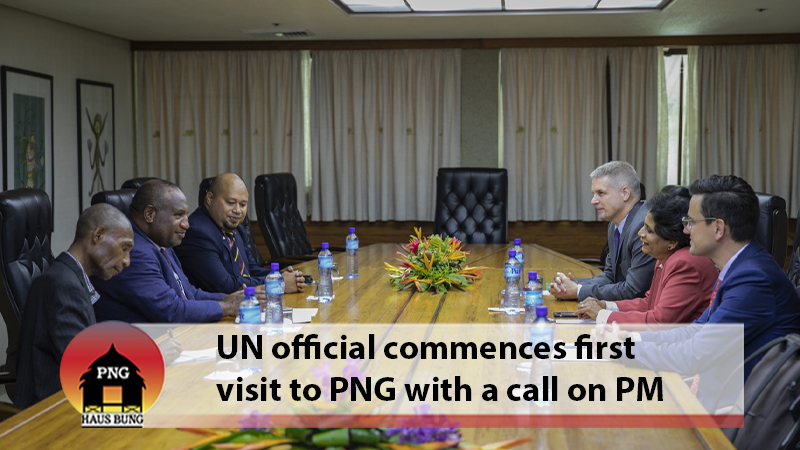 UNDP COMMITTED TO STRENGTHENING PARTNERSHIP WITH PNG
United Nations Assistant Secretary-General, UNDP Assistant Administrator and UNDP Regional Director for Asia and the Pacific, Ms. Kanni Wignaraja met with Papua New Guinea’s Prime Minister James Marape.
On her first visit to Papua New Guinea, she took the opportunity to highlight the long-standing partnership between UNDP and Papua New Guinea.
Ms. Wignaraja said, “I am pleased to finally visit Papua New Guinea. It is a place of incredible opportunity. UNDP has enjoyed a strong partnership with Papua New Guinea for many years and we remain committed to strengthening this partnership further in coming years. The world is in uncertain times. UNDP’s commitment is to support Papua New Guinea find solutions that will accelerate progress toward fulfilling the Sustainable Development Goals and transitioning to a green economy.”
A range of topics were discussed during this first meeting. These included the importance of Papua New Guinea pursuing a green economy transition, increasing efforts to empower women, and accelerating efforts to deliver on the 2030 Agenda.
During these discussions, Ms. Wignaraja drew attention to the continuing importance of maintaining global commitment to climate action.
Following COP 27, she reiterated that this included investment in a fundamental restructuring of economies towards renewable, low-carbon and sustainable technologies.
Ms. Wignaraja highlighted the importance of this particularly for Papua New Guinea where biodiversity and the scale of forest cover, made it a custodian of an irreplaceable international public good.
Ms. Wignaraja also took this opportunity to reaffirm the importance of further empowering women in Papua New Guinea.
Reflecting on the challenges that women continue to face, she highlighted the global experience which demonstrates that where women are able to fully participate in social, economic and political life, countries are more resilient, safer and more prosperous.
The recent release of the 2021 UNDP Human Development Report has shone a stoplight on growing global uncertainty showing declines in hard fought development gains among many countries as they pursue post-COVID recovery and navigate global economic uncertainty, been no exception to this.
Ms. Wignaraja reiterated the importance of addressing this decline, making up for lost ground on the 2030 Agenda.
Ms. Wignaraja will be in Papua New Guinea from 30 November to 4 December. She will call on senior political, government, civil society, and private sector leaders.
Published on December 2, 2022
 MCPNG RESPONDS TO MEDIA BEING ACCUSED OF BEING ANTI- PNG
The mainstream media in our independent country was this week accused of being anti- PNG and not being responsible in its role in the country.
This call was made in the confines of the National Parliament during Questions without Notice and was in reference to the front-page story of one of our daily papers featuring a story of a multi-homicide case in the Transgogol area of the Madang Province.
In response to this call, the government urged the media in the country to be more responsible in its coverage of stories, and ‘how it portrays the country’.
The Media Council of Papua New Guinea is compelled to provide several points of clarity in reassurance of its members’ collective and continued resolve as being both the watchdog of society, and when necessary, highlighting areas which need urgent government intervention and action – all in the interest and wellbeing of our audiences, WE, the people.
The homicides on which the article was based, occurred in the Transgogol area of Madang, renowned for instances such as these recent heinous crimes, being perpetuated by youths who have dropped out of grades eight or ten, and who have no available opportunities at the village level.
The Media in PNG continues to be responsible in its reporting, contrary to what is being portrayed by national leadership.
We must not pretend that violent crimes do not happen in our country.
The Media has a responsibility to report on them as brutally, and as truthfully as they are allowed too.
Every day, Editors and News Managers make important moral and ethical decisions on how much positive change they can create for the betterment of our country’s future, while operating within the confines of agreed to reporting guidelines for PNG Media.
All media newsrooms abide by and adhere to the MCPNG’s Code of Ethics, and their own story vetting processes. To suggest otherwise is an insult to the hard work of mainstream media organizations against social media users who upload uncensored, violent and gorish imagery with no consideration of taste and decency standards.
The media continues to promote daily positive stories of growth, innovation, and Papua New Guinean ingenuity and perseverance.
We do this because we understand the power of the written word and images. By the same token, we cannot turn a blind eye to the fact that:
• Alcoholism is rife. Nine out of every ten trauma cases in hospitals are alcohol- related; and nine out of every 10 cases of violence is related to alcohol.
• Violent crimes are happening in our country, and if we do not address them, they will only worsen.
The MCPNG and its members understand fully the responsibility and role the media can play in the future growth and development of our country and stands ready to work with the government in its responsibility to address current problem areas and create the conditions that allow our people to get out of the cycle of violence we are seeing.
The MCPNG acknowledges and is encouraged by the budgetary interventions in the areas of the regulation of alcohol, and increased support to the Law and Justice sector.
The media will continue to report honestly, truthfully, and fairly, on the implementation and realized impacts of these measures, and looks forward to seeing more tangible, nationally focused development discourse on the floor of the National Parliament, rather than the electorate, provincial and supporter-based focus that has become the norm in recent times.
The MCPNG looks forward to seeing government’s increased push for the implementation of the Whistleblower Act, and a Freedom of Information Bill which will strengthen transparency and increase scrutiny on good governance, or the lack of it.
Published on December 2, 2022
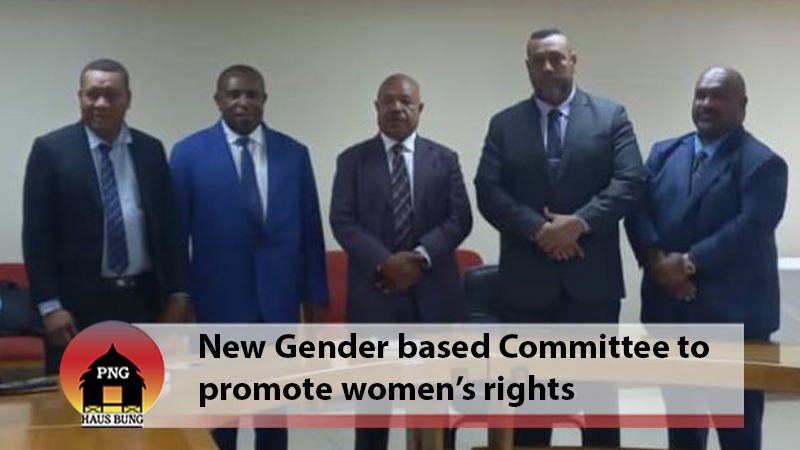 NEW MEMBERS OF GENDER EQUALITY PARLIAMENTARY COMMITTEE SWORN IN
As the 20 Days of Human Rights Activism campaign continues to be celebrated in PNG, five members of the new Permanent Parliamentary Committee on Gender Equality and Women’s Empowerment (GEWE) were sworn in yesterday at the National Parliament.
Governor Powes Parkop (Chairman), Governor Allan Bird (Deputy Chairman) and Committee members Hon. Marsh Narewec, Hon. Ricky Morris and Hon. Lohia Boe Samuel all took their oath of office and committed to using their mandate to progress women’s empowerment and to continue previous efforts to tackle gender-based violence.
Governor Chair Powes Parkop took the opportunity to make a short speech, thanking the Members for joining their Committee and using their power as Members of Parliament to take action to improve the lives of women and girls.
He again thanked former MP, Hon Charles Abel, for his invaluable contribution to addressing GBV, in his role as the former Chair of the Special Parliamentary Committee on GBV.
Governor Parkop stated: “We need to translate our words into deeds which is why I am so happy the Government committed to converting the previous ad hoc committee into a permanent committee and showing a strong commitment to this very important agenda for our country.
I am also very happy the scope of the committee has been broadened to address not only GBV, but also gender equality and women’s empowerment We have made many commitments globally and nationally in the past but have not made much progress.”
He went on to acknowledge: “We may not solve everything. It is not our jobs to go out and do the work.
But we do have the power to do oversight of government agencies at the national, sub-national and local levels and we will use it.
I want to tell the people that we will be a proactive committee. We will call government agencies before our committee to tell us what they are doing – and also what they are not doing – so that we can make sure this important human rights issue is being properly addressed”.
In closing, Governor Parkop noted: “These issues of gender equality and GBV affect half of our population – our women and girls – who for a long time have been feeling like they are treated like second class citizens in our country. This committee is just a start at addressing
these big challenges, but I look forward to working with my colleagues to take action. Once we work out our schedule, we will announce it and then we will get to work!”
The new Committee has a broader term of reference than the previous Special Parliamentary Committee on GBV.
In addition to examining all aspects related to addressing GBV, the Committee has been empowered to examine other issues that impact on gender equality, including women’s leadership, women’s economic empowerment and related GEWE reforms.
The Committee can also examine the role of the National Council of Women in promoting women’s rights.
The new Committee has seven members in total: Governor Rufina Peter (Central Province) and Hon William Bando will be sworn in on a later date. The Committee has a quorum of four people and can now commence its work.
The United Nations Development Programme (UNDP) will be providing technical support to the new Parliamentary Committee on GEWE and GBV as part of its gender programming and the EU-UN Spotlight Initiative.\
This support aims to address GEWE and Gender-BAed Violence and support longer-term efforts to promote women’s participation and leadership in the Parliament.
Published on December 2, 2022
 WERROR RESIGNS AS OTML CEO
The Board of Ok Tedi Mining Ltd announced that it has accepted the resignation of Managing Director and CEO, Musje Werror.
OTML Board Chairman, Dr. Roger Higgins, made the announcement today.
Dr. Higgins thanked Mr Werror for his contribution to Ok Tedi over many years, starting as a graduate trainee, working across all aspects of the business and culminating in his leadership of the company.
He wished Mr. Werror every success in his next venture.
The OTML Board will immediately commence the process to recruit the next Managing Director & CEO.
In the meantime, Mark Thompson, who is currently the General Manager Major Projects, has been appointed as the Acting Chief Executive Officer until the permanent incumbent is identified.
Published on December 2, 2022
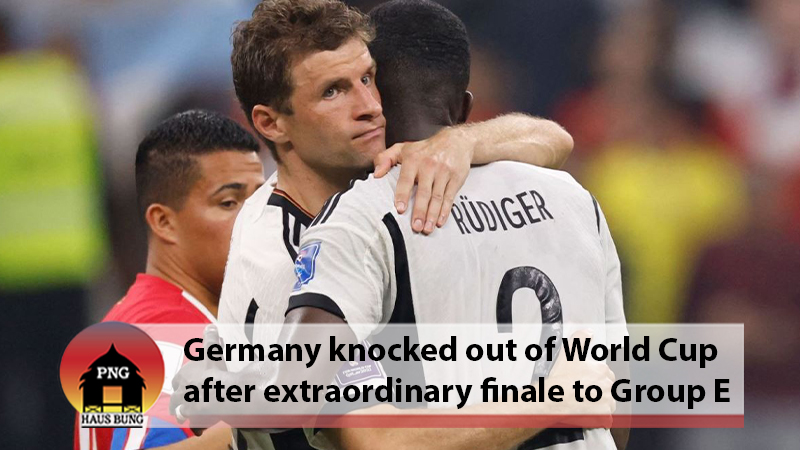 GERMANY FALL SHORT DESPITE BEATING COSTA RICA
Germany was knocked out of the 2022 World Cup on Thursday after a quite extraordinary finale to Group E, despite beating Costa Rica.
At varying points of the two games, fans of Spain and Japan as well as Costa Rica and Germany each thought that their countries might be on their way to the knockout phase.
Completely outplayed by Spain in the first half and trailing to Alvaro Morata’s first-half goal, somehow Japan stormed back to win 2-1 and top the group.
Japan’s two goals – from Ritsu Dōan and Ao Tanaka – came in the space of three minutes early in the second half.
Germany won 4-2 against Costa Rica, despite trailing at one point, but it wasn’t enough with Japan and Spain going through to the last 16.
Germany coach Hansi Flick said the “disappointment is huge” for Germany’s squad.
“In the first half I was disappointed and very angry at my team and how we allowed the opponent to come back,” Flick said, per Reuters.
“We wanted to score three or four goals in the first half but then we made mistakes. If we had converted those chances, 16 of them.
“But the tournament was not decided today for us. We did not have any efficiency at this tournament and that is why we were eliminated.”
The conclusion to Group E means Japan will face Croatia in the next round, while Spain will play Morocco.
The evening was momentous for another reason – Stéphanie Frappart became the first woman to referee a men’s World Cup match.
Alongside assistants Neuza Back from Brazil and Karen Diaz from Mexico, the French referee was part of an all-female refereeing trio overseeing the match between Germany and Costa Rica.
[caption id="attachment_31568" align="alignnone" width="1131"] Germany players leave the pitch after they failed to qualify for the last 16 of the 2022 World Cup.[/caption]
Everyone, catch your breath
Nine goals, controversial VAR decisions, and the four-time World Cup winner dumped out of the competition at the group stage just as Germany were at Russia 2018 – these two Group E games will live long in the memory.
Just hours after one European heavyweight, Belgium, had been knocked out, Spain and Germany faced the gauntlet, against Japan and Costa Rica, two teams that had been written off by most soccer experts as having little chance of reaching the last 16 before the World Cup started.
Despite those predictions, this was an evening that began with the possibility that all four teams were capable of progressing to the next stage.
Within the opening quarter of an hour of both games, both European sides looked destined to progress from the group.
At the Al Bayt Stadium, Serge Gnabry headed home in the 10th minute to give Germany a vital lead as it battled to rekindle its hopes of qualifying after a poor start to its campaign when it surprisingly lost to Japan.
Over at the Khalifa International Stadium, Morata headed home a sumptuous cross from right back César Azpilicueta to put Spain ahead.
In doing so, Morata became the second player to score in his first three World Cup appearances for Spain, after Telmo Zarra in 1950, according to Opta.
Following the goal, with both European sides sitting in the qualification spots, Spain and Germany dominated proceedings for the rest of the first half, with Spain enjoying 78% of the possession while Germany had 65% as they restricted the opposition team’s openings respectively.
But the preeminence of the European teams was soon to be challenged – within minutes of the second half beginning in both games, the situation in the group had changed completely.
As he did in the famous victory over Germany, Japan coach Hajime Moriyasu used his substitutes masterfully, bringing on Dōan and his left-footed strike brought Japan level.
Moments later, Tanaka gave the Samurai Blue a shock lead which threw the group into jeopardy.
Tanaka’s goal didn’t come without controversy though. A VAR review ruled the ball hadn’t gone out of play before Tanaka tapped home the cross for a goal.
[caption id="attachment_31569" align="alignnone" width="906"] Wataru Endo celebrates with teammates after Japan qualified for the knockout stages of the World Cup.[/caption]
Just when things seemed like they couldn’t get any wilder – and totally against the run of play – Costa Rica leveled the scores against Germany as Yeltsin Tejeda smashed home a rebound after Manuel Neuer couldn’t hold a powerful effort from Kendall Waston.
But the mental maths for coaches, players and fans was only just beginning.
Costa Rica took a stunning lead as Juan Pablo Vargas prodded home after an frantic goalmouth scramble to leave Germany trailing.
With just over 20 minutes remaining in the two games, Spain and Germany – both recent World Cup winners – were in danger of going home.
Costa Rica’s hopes were quickly dashed as a quickfire double from substitute Kai Havertz and a late Niclas Füllkrug goal ensured Germany – after a rollercoaster evening – would claim three points.
However, Spain’s 7-0 win over Costa Rica in its first group game – thereby ensuring a healthy goal difference – was now proving a lifeline to Luis Enrique’s side getting out of the group and condemning Germany to finish third.
Germany desperately needed a Spain goal to climb back into the qualification spots. But Spain was unable to break a resolute Japan defense down, and never really troubled Shūichi Gonda in goal, despite seven minutes of added time.
After scraping through thanks to its goal difference, Spain coach Enrique was critical of his side’s performance.
“I am not happy at all. Yes, we have qualified, I would have liked to be on top of winning this game. This was impossible because in five minutes, Japan scored two goals … we were out, we were dismantled,” Enrique said during a press conference, per Reuters.
Source: CNN News
Published on December 2, 2022
 PM TELLS HEADS OF DEPARTMENTS AND AGENCIES TO SUBMIT REPORTS
Prime Minister James Marape has reminded heads of Government departments and agencies to submit their annual reports by March 31, 2023, to show what they have achieved in 2022.
He said yesterday (December 1, 2022) that this would ensure timely and regular checks and balances on Government departments and agencies.
“All heads of Government departments and agencies are required to report back to us, by March 31, 2023, on what they have done for the country,” PM Marape said.
“We will not tolerate any late reports and warn, in no uncertain terms, that failure to comply with this deadline will result in termination.
“All reports, covering what they have done in 2022, should be handed in to the Chief Secretary’s Office. “We want to operate our country in a smarter, business-like, modus-operandi.
“As the heads of departments and agencies give in their reports, we will get the Auditor-General to hire independent audit firms outside of Government, to check on the reports.
“This is for the benefit of our tax-payers and the ordinary people of Papua New Guinea.”
PM Marape said his Government was not a new one, but a continuing one, and all heads of departments and agencies should know what was required of them.
“We want to do better for our country,” he said. “We are in the process of taking back our country and putting it back on the right road.
“The people have given us their mandate and we want to do the right thing for them.”
Published on December 2, 2022
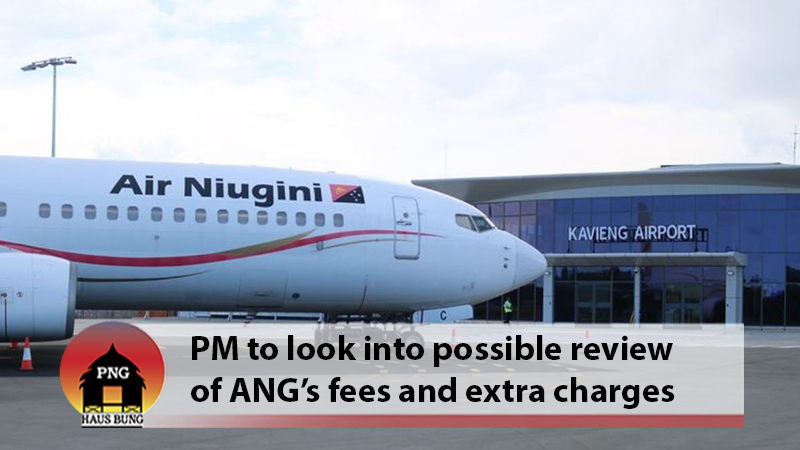 MARAPE SAYS AIR NIUGINI’S FEES, EXTRA CHARGES CAN BE LOOKED INTO
Prime Minister James Marape has assured the traveling Papua New Guinean public that he would get the two ministers jointly responsible for Air Niugini to look into the possible review of fees and extra charges that the airline company is imposing upon tickets.
The Prime Minister said while the Government cannot interfere with the costs of the tickets because of Air Niugini’s ‘cost structure’, fees and charges, however, could be looked at and he would get the ministers for State-owned Enterpise and Transport & Civil Aviation to look into the matter.
Prime Minister Marape was responding to Member for Menyamya Hon. Solen Loifa yesterday (011222) in Parliament during Questions Without Notice when the Member asked for some reprieve in the fees the airline is charging on top of already-expensive airline tickets.
“Air Niugini has a cost structure and requirements to operate at a certain level. For the ticket costs, we cannot influence too much. “
But if there is any space in giving relief to the public, we can ask Air Niugini.
“For some of these fees associated to the ticket, I will get the Minister for State-Owned Enterprise and the Minister for Transport & Civil Aviation to see into these fees that are built into the costs. Then we will get back to the Member and the people,” PM Marape said.
Published on December 2, 2022
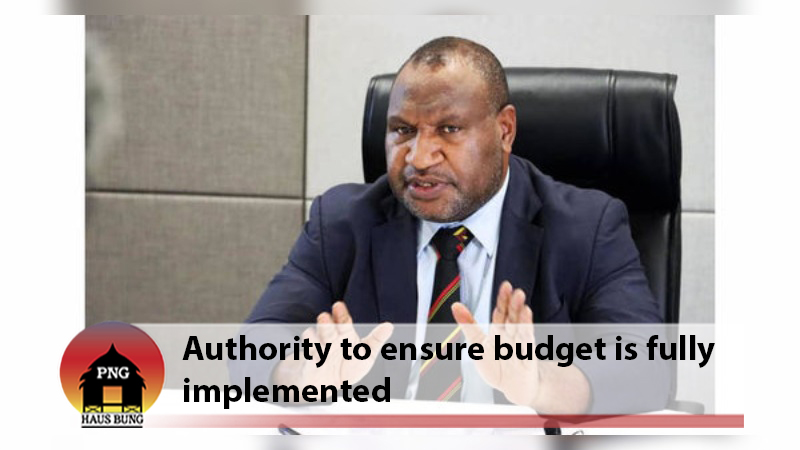 PM ANNOUNCES ESTABLISHMENT OF NATIONAL MONITORING AUTHORITY
Prime Minister James Marape has announced to the people of Papua New Guinea that a National Monitoring Authority (NMA) will be set up next year to ensure that the National Budget is implemented and that the Government’s visions and aspirations are realized.
He said yesterday, fresh from delivery of the 2023 Budget on Tuesday (November 29, 2022), that the NMA would be comprised of bodies like National Research Institute, National Economic and Fiscal Commission, Transparency International, National Council of Churches and others.
“We will also have representation of the Provincial Governors, Inter-Government Relations Department, and Central Agencies,” PM Marape said.
“We will check and ensure that all intentions of the Budget are delivered to expectations.
“We have just delivered the biggest-ever K24.5 billion Budget and we want to ensure that it delivers positive outcomes for the country.
“We want to develop our country and not waste and squander money on unnecessary areas. “Our focus for 2023 is Law-and-Order, Education, Health, Infrastructure and Economic Development.
“We want our people to develop their agriculture, forestry, fisheries, tourism and others instead of being overly dependent on oil, gas and mining.”
PM Marape said the 2023 Budget had noble intentions for PNG and the NMA – with representation of the people of PNG - would keep a close eye on implementation of the 2023 Budget and others into the future.
“We are also looking at getting professional auditing firms to audit Government books, and check Government programmes, to ensure that we are working for our people,” he said.
“We are also looking at engaging independent recruitment firms to recruit police, soldiers, warders and public servants to ensure that we get the best young people without accusations of bias and nepotism.
“We want the Budget to deliver for our people, instead of appropriating and spending without ensuring maximum return, as we have done for the last 47 years.”
Published on December 2, 2022