

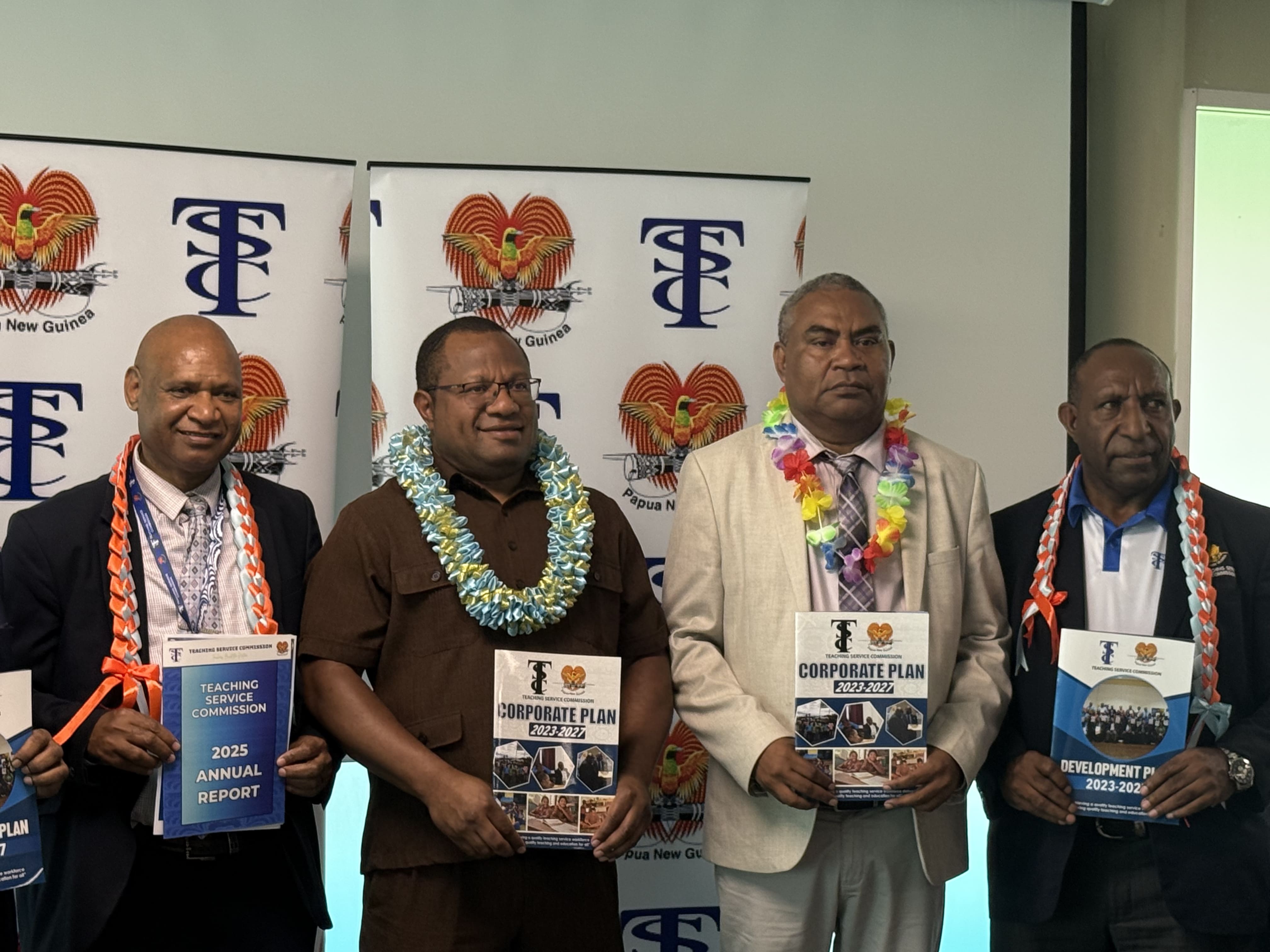
The Teaching Service Commission (TSC) has launched its Corporate Plan, Teaching Service Development Plan, and a new official website.
This effort aims to modernize teacher administration and strengthen education governance across Papua New Guinea after 53 years of operating through manual record-keeping.
Chairman of the Teaching Service Commission Maini Mike Ugaia, said the institution is now entering a new era of digital transformation, accountability, and strategic planning designed to improve services for nearly 70, 000 teachers nationwide.
“Today, we stand at a crossroads of tradition and transformation,” said Chairman Ugaia. “For over five decades, this Commission has largely relied on manual systems.”
“Today, we break that cycle and embrace a future defined by digital efficiency and strategic clarity.”
The Chairman acknowledged the leadership of Prime Minister James Marape and the Marape-Rosso government for directing reforms aimed at modernizing public service institutions.
He said the Prime Minister had challenged the Commission to “modernize or be left behind,” with a clear directive for TSC to become a more flexible and decentralized body serving teachers in districts and remote schools rather than remaining centered in Port Moresby.
“We are moving away from being a Port Moresby-centric office to a service that is felt in every school in Papua New Guinea.”
Meanwhile, Minister for Higher Education, Research, Science, Technology and Sports, and Acting Minister for Education, Kinoka Feo, described the launch as a historic milestone in reforming the “engine room” of the country’s education system.
“We are not merely launching documents and digital platforms; we are ushering in a new era of accountability, efficiency and modernization for the nearly 70, 000 teachers who faithfully serve our nation.”
He reiterated the government’s commitment to ensuring no teacher is left behind, stressing that teacher grievances, payroll issues, appointments, and administrative matters must be handled with greater speed, fairness, and transparency.
The newly launched TSC Corporate Plan will serve as the Commission’s institutional roadmap, aligning operations with the Government’s Medium-Term Development Plan IV.
Key priorities include institutional strengthening, improved governance, and better service delivery systems to manage the country’s large teaching workforce.
The plan also outlines efforts toward financial independence, including advocacy for a single-line budget aimed at prioritizing teacher salaries, entitlements, and operational efficiency.
Simultaneously, the Teaching Service Development Plan focuses on strengthening the teaching profession through workforce development, professional standards, and clearer career pathways.
Chairman Ugaia said the commission plans to implement stricter screening processes to ensure only qualified professionals enter the system, while also expanding professional development opportunities for existing teachers as quality education starts with quality teachers.
A key highlight of the launch was the unveiling of the Commission’s official website, which leaders described as a “digital gateway” for teachers across the country.
The platform will allow teachers to access and download appointment forms, leave forms, policies, circulars, and other important documents online.
Minister Feo said that this is expected to significantly reduce the need for teachers, to travel to provincial centers or the national capital for basic administrative services.
“For far too long, many teachers have had to spend time and money traveling just to check files or collect forms,” he said noting that this platform brings the Commission directly to the teacher’s doorstep.”
He emphasized the importance of digitizing TSC records to improve accountability and eliminate longstanding payroll issues.
With major challenges faced over the years including, coordination of teacher attendance, performance monitoring, salary payments, and entitlements, digitizing records and services will ensure that the government can improve payroll accuracy, identify ghost names, reduce waste, and ensure public funds are properly directed to active teachers.
Despite the reforms, the Commission acknowledged that significant challenges remain, particularly in infrastructure and funding.
Moreover, the Chairman called on Minister Feo to continue advocating for TSC reforms at the Cabinet level to ensure the plans are fully implemented rather than remaining policy documents.
In closing, Chairman Ugaia stated that the Marape-Rosso government recognizes the critical role teachers play in national development and is actively working with the Department of Personnel Management to improve teacher remuneration and conditions, with specific funding provisions targeted for the 2027 National Budget.
“We face challenges in infrastructure and funding, but with continued government support, these reforms can transform lives in our schools.”